En esta sección, te enseñaremos a identificar las diferentes situaciones para emplear el futuro simple. Anímate a resolver los ejercicios que te planteamos y enriquece tus conocimientos.
El Futuro Simple (o Futuro Imperfecto) se utiliza para hablar de acciones futuras o para expresar probabilidad en el presente. Es uno de los tiempos más sencillos de conjugar. The Simple Future is used to talk about future actions or to express probability in the present. It is one of the easiest tenses to conjugate.
1. Conjugación Regular del Futuro Simple (Regular Formation)
A diferencia de otros tiempos, no quitamos la terminación (-AR, -ER, -IR). Añadimos las terminaciones directamente al infinitivo. Unlike other tenses, we do not remove the ending. We add the endings directly to the infinitive.
Infinitivo + é, ás, á, emos, éis, án
Persona
Terminación
Ejemplo (Hablar)
Yo
-é
hablaré
Tú
-ás
hablarás
Él / Ella / Usted
-á
hablará
Nosotros / as
-emos
hablaremos
Vosotros / as
-éis
hablaréis
Ellos / Ellas / Uds.
-án
hablarán
2. Verbos Irregulares (Irregular Verbs)
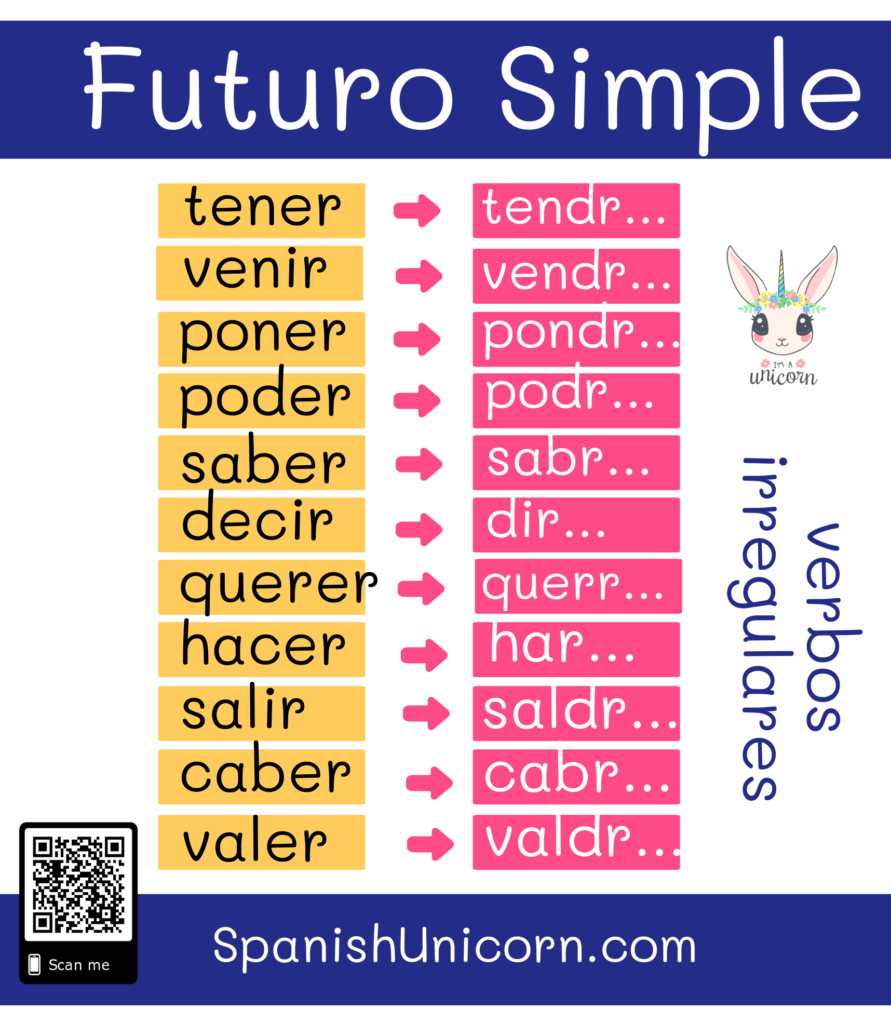
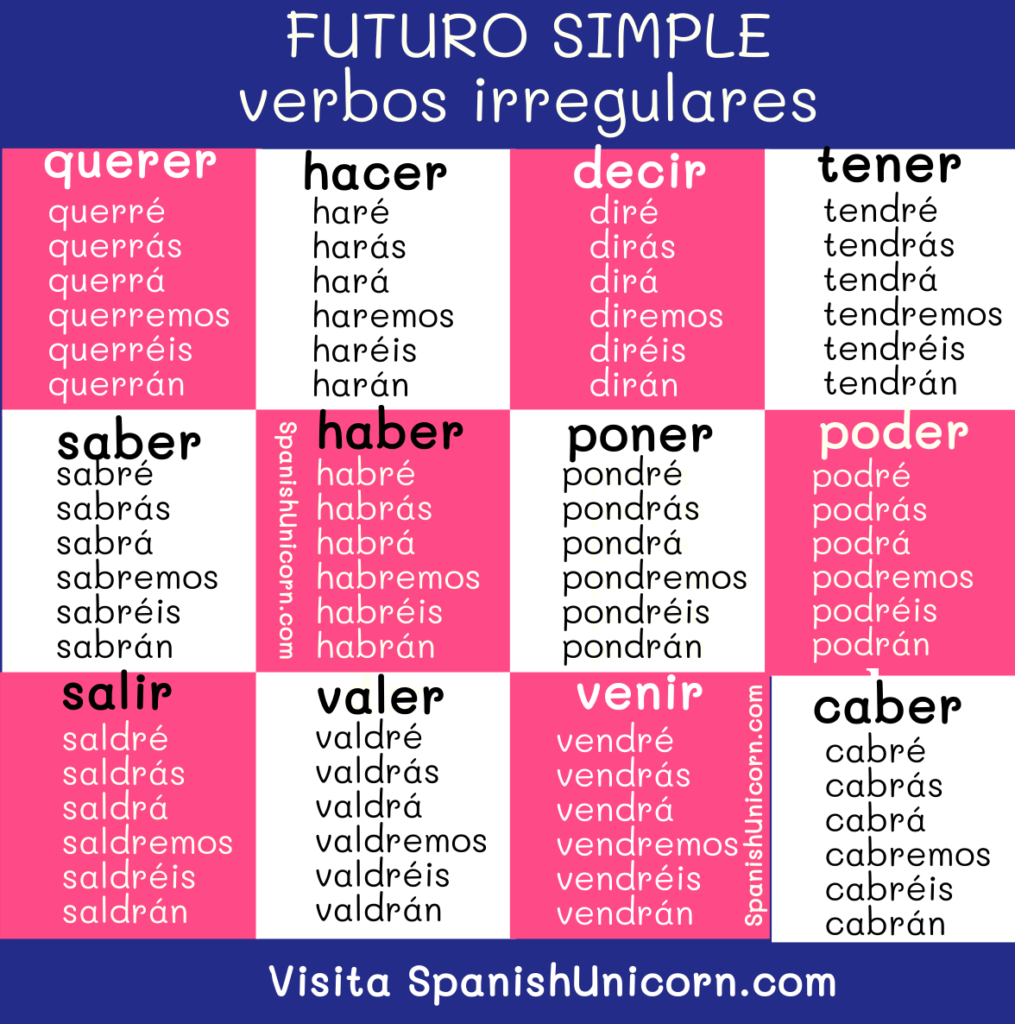
Los verbos irregulares mantienen las mismas terminaciones, pero cambia su raíz. Irregular verbs keep the same endings, but their stem changes.
La lista completa y organizada de los verbos irregulares en Futuro Simple: Recuerda que, aunque la raíz cambie, las terminaciones son siempre las mismas para todos los verbos: -é, -ás, -á, -emos, -éis, -án.
1. Grupo A: Sustituyen la ‘e’ o la ‘i’ por una ‘d’
Estos son muy comunes. La vocal del infinitivo desaparece y se añade una “d” antes de la terminación.
En este grupo, simplemente se elimina la vocal de la terminación del infinitivo.
Infinitivo
Raíz irregular
Ejemplo (Yo)
Tener
tendr-
tendré
Poner
pondr-
pondré
Salir
saldr-
saldré
Venir
vendr-
vendré
Valer
valdr-
valdré
2. Grupo B: Pierden la vocal ‘e’
Infinitivo
Raíz irregular
Ejemplo (Yo)
Saber
sabr-
sabré
Poder
podr-
podré
Querer
querr-
querré
Haber
habr-
habré
Caber
cabr-
cabré
3. Grupo C: Raíces especiales (muy irregulares)
Estos dos verbos cambian de forma más drástica y son esenciales para el día a día.
Infinitivo
Raíz irregular
Ejemplo (Yo)
Hacer
har-
haré
Decir
dir-
diré
Un truco valioso
Los verbos compuestos siguen la misma irregularidad que el verbo base. Esto ayuda mucho a mis alumnos avanzados:
Poner → pondré | Suponer → supondré
Tener → tendré | Mantener → mantendré
Venir → vendré | Prevenir → prevendré
Hacer → haré |
Futuro Simple: Juego con Verbos Irregulares
Pasa el ratón para ver la raíz / Hover to see the irregular stem
Tener
Ver raíz / See stem
tendr-
Hacer
Ver raíz / See stem
har-
Decir
Ver raíz / See stem
dir-
Poner
Ver raíz / See stem
pondr-
Saber
Ver raíz / See stem
sabr-
Querer
Ver raíz / See stem
querr-
¡Ponte a prueba! (Crossword: Test yourself!) Futuro simple
Acciones futuras:Mañana comeré con mi abuela. (Future actions)
Probabilidad en el presente:¿Dónde está María? Estará en su casa. (Probability in the present: “She is probably at home”).
Predicciones:En el futuro, los coches volarán. (Predictions).
4. Marcadores Temporales (Time Markers)
Mañana / Pasado mañana (Tomorrow / Day after tomorrow)
El próximo lunes / mes / año (Next Monday / month / year)
La semana que viene (Next week) / el lunes / martes / miércoles / jueves / viernes /sábado / domingo que viene
Dentro de… (In… [amount of time])
5. Ejemplos con Futuro Simple (Examples)
En esta sección, verás cómo se utiliza el futuro simple en contextos reales. Hemos dividido los ejemplos en tres categorías principales para que entiendas no solo cómo conjugar, sino cuándo es mejor usar este tiempo verbal. Presta atención a los verbos en negrita y a los marcadores de tiempo.
In this section, you will see how the simple future is used in real contexts. We have divided the examples into three main categories so you understand not only how to conjugate, but also when it is best to use this tense. Pay attention to the bold verbs and the time markers.
1. Plans and Intentions (Planes e intenciones)
Explicación: Utilizamos el futuro simple para hablar de acciones programadas o decisiones que hemos tomado para un momento específico en el futuro. Explanation: We use the simple future to talk about scheduled actions or decisions made for a specific moment in the future.
Spanish (Español)
English (Inglés)
La semana que viene iré a Madrid porque tengo que comprar un libro.
Next week I will go to Madrid because I have to buy a book.
Con mis amigos haré una gran fiesta para festejar el cumpleaños de Tomás.
With my friends, I will have a big party to celebrate Tomás’s birthday.
Pasado mañana llamarán por teléfono a la abuela de Gabi.
The day after tomorrow they will call Gabi’s grandmother by phone.
El lunes presentaré una prueba difícil de Matemáticas.
On Monday I will take a difficult Math exam.
En verano tomaré un vuelo directo a Chile.
In summer I will take a direct flight to Chile.
Mis padres mañana cantarán una ópera famosa de Verdi.
My parents will sing a famous Verdi opera tomorrow.
Dentro de dos años, terminaremos nuestros estudios.
In two years, we will finish our studies.
2. Predictions about the World (Predicciones)
Explicación: Lo usamos para expresar lo que creemos que sucederá en el mundo, en el clima o en la sociedad a largo plazo. Explanation: We use it to express what we believe will happen in the world, the weather, or society in the long term.
Spanish (Español)
English (Inglés)
En el año 2050, los coches volarán.
In the year 2050, cars will fly.
La tecnología ayudará a resolver muchos problemas climáticos.
Technology will help solve many climate problems.
No habrá más contaminación en los océanos algún día.
There will be no more pollution in the oceans someday.
3. Probabilidad en el Presente (Probability in the Present)
Explicación: ¡Cuidado! Este uso es muy común en español. Se usa para hacer una suposición o “adivinar” algo que está pasando ahora mismo. Explanation: Be careful! This use is very common in Spanish. It is used to make a guess or “suppose” something that is happening right now.
Español (Spanish)
Inglés (English)
¿Qué hora es? No sé, serán las tres de la tarde.
What time is it? I don’t know, it must be around three p.m.
¿Dónde está el profesor? Estará en la cafetería.
Where is the teacher? He is probably in the cafeteria.
¿Quién llama a la puerta? Será el cartero.
Who is knocking? It must be the mailman.
5. Ejercicios de gramática española (futuro)
Ejercicio 1: Verbos Regulares (Regular Verbs)
Ejercicio 2: Verbos Irregulares (Irregular Verbs)
Ejercicio 3: Predicciones del Futuro (Future Predictions)
Ejercicio 4: Probabilidad en el presente (Probability in the Present)
Soluciones
Ejercicio 1: Verbos Regulares (Regular Verbs)
Instrucciones: Conjuga los verbos entre paréntesis en Futuro Simple. / Conjugate the verbs in parentheses in Simple Future.
Yo (hablar) hablaré con el jefe mañana por la mañana.
Nosotros (comer) comeremos en un restaurante italiano el próximo domingo.
El próximo año, ellos (vivir) vivirán en una casa nueva cerca de la playa.
Si estudias mucho, tú (aprender) aprenderás español muy rápido.
Vosotros (escribir) escribiréis un libro sobre vuestros viajes algún día.
La semana que viene, ella (comprar) comprará un coche eléctrico.
Ejercicio 2: Verbos Irregulares (Irregular Verbs)
Instrucciones: Completa las frases con la forma correcta de los verbos irregulares. / Complete the sentences with the correct form of the irregular verbs.
(Tener, yo) Tendré mucho tiempo libre durante las vacaciones de verano.
¿Qué (hacer, tú) harás cuando termines la universidad?
El director (decir) dirá los resultados del examen el próximo lunes.
Mis amigos (salir) saldrán de fiesta este viernes por la noche.
En el futuro, los científicos (saber) sabrán cómo curar muchas enfermedades.
¿(Poder, nosotros) Podremos viajar a Marte en el año 2050?
Ejercicio 3: Predicciones del Futuro (Future Predictions)
Instrucciones: Lee las predicciones sobre el mundo en el futuro y completa. / Read the predictions about the future world and complete.
En unos años, los robots (trabajar) trabajarán en todas las fábricas del mundo.
No (haber) habrá coches de gasolina en las ciudades modernas.
La inteligencia artificial (ayudar) ayudará a los médicos en los hospitales.
Mucha gente (viajar) viajará al espacio por vacaciones.
El clima (cambiar) cambiará drásticamente si no cuidamos el planeta.
(Venir) Vendrán nuevas tecnologías que todavía no podemos imaginar.
Ejercicio 4: Probabilidad en el presente (Probability in the Present)
Instrucciones: Usa el futuro para expresar suposición o probabilidad. / Use the future tense to express a guess or probability.
¿Dónde está Juan? No lo sé, (estar) estará en su oficina trabajando.
¿Qué hora es? No tengo reloj, pero (ser) serán las diez de la noche.
María no contesta el teléfono; (tener) tendrá mucho trabajo ahora mismo.
¿Quién llama a la puerta a esta hora? (Ser) Será el cartero con un paquete.
Ese coche es muy lujoso, (valer) valdrá muchísimo dinero.
Ellos no han llegado todavía; (venir) vendrán en el próximo tren.
Me encanta crear recursos para que aprendas español de forma divertida y efectiva. Si SpanishUnicorn te ha ayudado o te ha gustado el contenido, puedes invitarme un café virtual y ayudarme a seguir creando más materiales, ejercicios y juegos para ti. ¡Cada aporte hace la diferencia! ¡Gracias por tu apoyo!