
Ser vs Estar: Differences, Rules and Exercises
On 02/11/2026 by SpanishUnicornLast Updated on 02/11/2026 by SpanishUnicorn
💡 Quick answer: Use ser when you identify or classify someone or something, describe a defining quality, give an origin, tell the time, or say where an event happens. Use estar for the location of people and objects and for their condition or state. Some adjectives work with both verbs, but the meaning changes. Duration alone is not the rule.
English has one everyday verb for both I am a student and I am tired. Spanish makes two different choices:
- Soy estudiante. — I am a student.
- Estoy cansado / cansada. — I am tired.
The difference is not that being a student lasts forever and being tired does not. The difference is what kind of information you are giving. That is the skill you will practice in this lesson.
Your goal: By the end, you should be able to explain why a sentence needs ser or estar, not just guess the verb.
1. Why English speakers mix up ser and estar
Both verbs often translate as to be, so translating one English word at a time will not work. Compare:
| English | Natural Spanish | Why? |
|---|---|---|
| I am from Chicago. | Soy de Chicago. | Origin → ser |
| I am in Chicago. | Estoy en Chicago. | Location → estar |
| My sister is a doctor. | Mi hermana es médica. | Profession → ser |
| My sister is nervous. | Mi hermana está nerviosa. | State or feeling → estar |
| The class is at the library. | La clase es en la biblioteca. | Event venue → ser |
| The library is next to the park. | La biblioteca está junto al parque. | Building location → estar |
Notice the last two sentences. In English, both contain is at. In Spanish, the subject changes the choice: a class taking place somewhere is an event; a building located somewhere is a thing.
2. When to use ser
Think of ser when you are telling someone who or what something is, where someone is from, or a characteristic you are presenting as part of their description. It is also the normal verb for time, dates, and the time or place of events.
Identity, professions, origin, and relationships
- Soy Lucía. — I’m Lucía. (Identity.)
- Mi padre es enfermero. — My father is a nurse. (Profession.)
- Somos de Canadá. — We’re from Canada. (Origin.)
- Ana y Paula son hermanas. — Ana and Paula are sisters. (Relationship.)
English speaker’s tip: With an unmodified profession, Spanish normally has no un/una: Soy profesora, not Soy una profesora. An article may appear when you add a description: Es una profesora excelente.
Qualities, material, and ownership
- Mi vecino es amable. — My neighbor is kind. (A general description.)
- La mesa es de madera. — The table is made of wood. (Material.)
- Este libro es de Marta. — This book belongs to Marta. (Ownership.)
These are descriptions, not promises that nothing will ever change. A kind person can have a bad day and a wooden table can be replaced. Ser still fits the meaning of these sentences.
Time, dates, and events
- Son las ocho. — It’s eight o’clock.
- Hoy es viernes. — Today is Friday.
- El examen es mañana. — The exam is tomorrow.
- La reunión es en la oficina. — The meeting is at the office.
An event takes place somewhere; a person or object is located somewhere. This is why La reunión es en la oficina and Mi jefe está en la oficina can both be correct.
3. When to use estar
Use estar when you tell someone where a person or thing is or describe a state, condition, feeling, or result.
The location of people and things
- Estoy en casa. — I’m at home.
- ¿Dónde están las llaves? — Where are the keys?
- El museo está en el centro. — The museum is downtown.
Even if a museum has stood in the same place for centuries, está is still the normal choice for its location. The location rule is about the information, not the length of time.
Feelings, conditions, and results
- Estoy contenta. — I’m happy. (How I feel.)
- El café está frío. — The coffee is cold. (Its condition.)
- La puerta está abierta. — The door is open. (Its state.)
- El vaso está roto. — The glass is broken. (A result.)
Many of these expressions have a different meaning — or are simply unnatural — with ser. It helps to learn everyday combinations such as estar cansado, estar nervioso, estar abierto and estar roto as useful phrases.
One A2 extra: Estar also helps form actions in progress: Estoy leyendo. — I’m reading. We will leave that construction to a separate lesson on estar + gerundio.
4. A decision guide you can actually use
Before you choose a verb, complete this sentence in your head: “I want to tell someone…”
- …who or what someone is, where they are from, or what they are like in general. Choose ser: Elena es argentina. Es arquitecta.
- …where a person or object is. Choose estar: Elena está en el museo.
- …how someone feels or the condition of something. Choose estar: Elena está cansada. La ventana está cerrada.
- …when or where an event takes place. Choose ser: La visita es el sábado. Es en el museo.
- …a quality that could have more than one interpretation. Check the intended meaning: Ella es lista (smart) versus Ella está lista (ready).
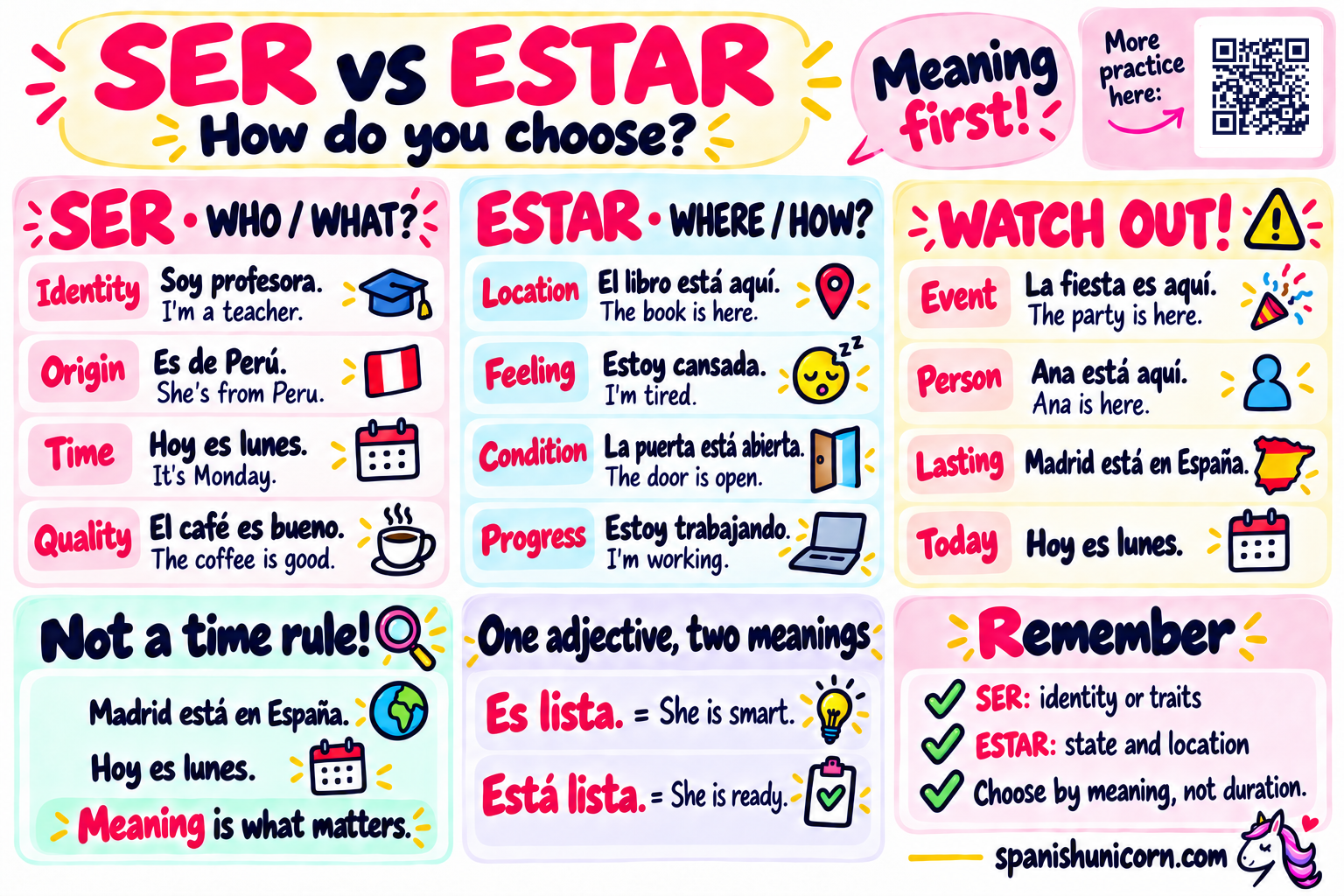
Save this decision guide and use it before each exercise. It is more reliable than asking whether a situation is permanent.
A 30-second check
Which verb fits each meaning?
- ¿Dónde ___ la profesora? (Where is the teacher?)
- ¿Dónde ___ la clase? (Where is the class taking place?)
Answers: ¿Dónde está la profesora? A person has a location. ¿Dónde es la clase? A class is an event that takes place somewhere.
5. Why “permanent vs. temporary” is not the real rule
You may have learned: ser = permanent and estar = temporary. That shortcut sometimes points you in the right direction, but it also produces avoidable errors.
Temporary fact, but ser:
- Hoy es viernes. — Today is Friday. It won’t be Friday tomorrow, but Spanish uses ser for the day.
Long-lasting fact, but estar:
- Madrid está en España. — Madrid is in Spain. This is a location, even though the city is not about to move.
- La estatua está rota. — The statue is broken. The damage might never be repaired, but rota describes its condition or result.
One adjective, two readings:
- Mi hermana es tranquila. — My sister is a calm person.
- Mi hermana está tranquila. — My sister is calm right now / in this situation.
The contrast is often between a characteristic you are presenting as part of a description and a state you are observing in a situation. But not every adjective allows both verbs, and some pairs change meaning more dramatically. That is why context matters.
6. Present-tense forms of ser and estar
First decide the meaning. Then choose the correct form for the subject.
| Subject | Ser | Estar |
|---|---|---|
| yo | soy | estoy |
| tú | eres | estás |
| él / ella / usted | es | está |
| nosotros / nosotras | somos | estamos |
| vosotros / vosotras | sois | estáis |
| ellos / ellas / ustedes | son | están |
In most of Latin America, ustedes is the regular plural you. In Spain, vosotros/vosotras is also common for informal plural you.
Spanish often leaves the subject pronoun out because the verb already tells you who is speaking: Soy de Boston is a complete sentence. You do not need yo every time.
Notice the written accents: estás, está and están. An accent is part of the correct spelling, not decoration.
7. When the same adjective changes the message
These pairs are especially helpful because you can see why blindly translating is does not work.
| Ser | Estar |
|---|---|
| Ella es lista. — She is smart. | Ella está lista. — She is ready. |
| Él es aburrido. — He is boring. | Él está aburrido. — He is bored. |
| Las manzanas son verdes. — The apples are green (in color). | Las manzanas están verdes. — The apples are unripe. |
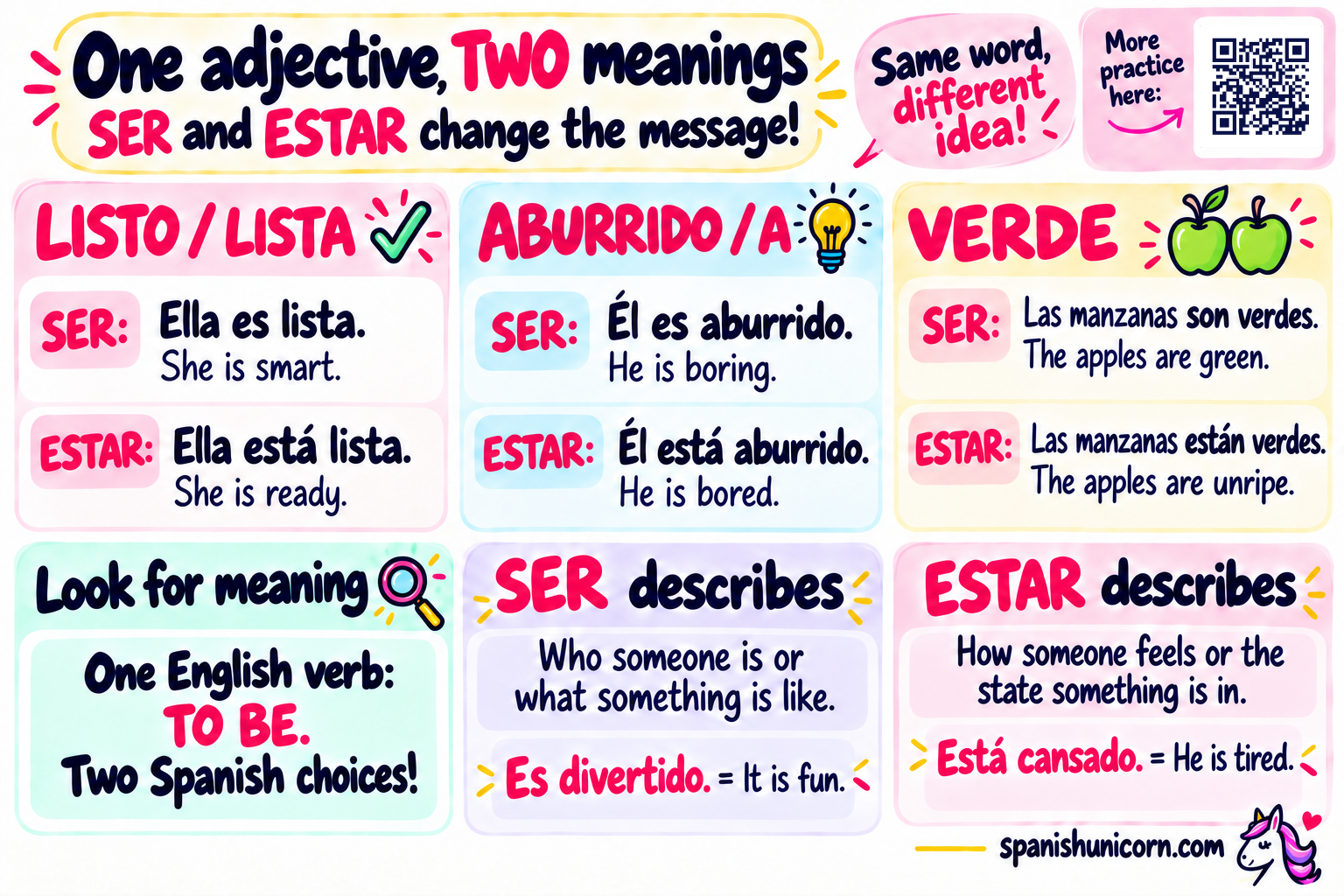
Two things to remember:
- These are not six random phrases to memorize separately. They show how one Spanish adjective can communicate different information depending on the verb.
- Context must make the intended message clear. If an exercise simply asks Las manzanas ___ verdes with no clue, both answers may be possible. A good exercise will tell you whether it means color or ripeness.
8. English-to-Spanish traps you can catch
Trap 1: “I’m a teacher” does not mean “I’m being a teacher today”
The normal statement of someone’s job is Soy profesora / profesor. Choose ser even if that person may change careers next year.
Trap 2: “It’s at the library” needs a subject
- El libro está en la biblioteca. — The book is at the library.
- La charla es en la biblioteca. — The talk is at the library.
The English phrase is at looks identical, but the Spanish subject is an object in one sentence and an event in the other.
Trap 3: “There is” is not ser or estar
- Hay una cafetería en esta calle. — There is a café on this street. (Introducing its existence.)
- La cafetería está en esta calle. — The café is on this street. (Locating a café you already know about.)
Use hay to say that someone or something exists in a place. Use estar to locate a specific person or thing. Practice hay, está and están if these sentences feel similar.
Trap 4: English “I am bored” is not “I am boring”
- Estoy aburrido / aburrida. — I’m bored.
- Soy aburrido / aburrida. — I’m boring.
Both are grammatical, but they make different claims. Think about the message before choosing a verb.
9. Common mistakes and how to correct them
| What the learner says | Better Spanish | What went wrong |
|---|---|---|
| ❌ Estoy estudiante. | ✅ Soy estudiante. | A profession or role used as identification normally takes ser. |
| ❌ Soy en casa. | ✅ Estoy en casa. | You are locating a person, not identifying them. |
| ❌ Madrid es en España. | ✅ Madrid está en España. | A city is a place being located, not an event taking place. |
| ❌ La fiesta está en casa de Ana. | ✅ La fiesta es en casa de Ana. | You are giving the venue of an event. |
| ❌ Soy aburrida when you mean “I’m bored.” | ✅ Estoy aburrida. | Soy aburrida means “I’m boring.” It is grammatical, but wrong for that meaning. |
| ❌ Hay mi mochila en la silla. | ✅ Mi mochila está en la silla. | You are locating your particular backpack, not introducing the existence of one. |
Teacher’s note: When a learner picks the wrong verb, asking “What meaning were you trying to express?” is more useful than repeating “ser is permanent; estar is temporary.” Have them label the sentence identity / origin / location / condition / event, then choose again. This makes the reasoning reusable in new situations.
10. Real-life Spanish: Maya’s first day in Seville
Read the short story. Every bold verb has a reason.
Maya es de Boston y es estudiante de español. Esta semana está en Sevilla. Su hostal está cerca del centro. Hoy es martes y la clase es en una biblioteca pequeña. La biblioteca está junto al parque. Maya está nerviosa, pero su profesora es muy paciente.
English: Maya is from Boston and is a student of Spanish. This week she is in Seville. Her hostel is near the city center. Today is Tuesday, and the class is in a small library. The library is next to the park. Maya feels nervous, but her teacher is very patient.
| Phrase | Why that verb? |
|---|---|
| es de Boston / es estudiante | Origin and identity → ser |
| está en Sevilla / está cerca del centro | Location of a person and building → estar |
| hoy es martes | Day of the week → ser |
| la clase es en una biblioteca | Venue of a class as an event → ser |
| la biblioteca está junto al parque | Location of a building → estar |
| está nerviosa / es muy paciente | State in this situation / general description → estar / ser |
Your turn: If Maya is no longer nervous, change just one sentence: Maya está tranquila. Why is it still estar? Because you are describing her condition in that situation. If you wanted to describe her personality, Maya es tranquila would communicate something different.
Before you leave: try three new situations
Without looking at the guide, translate these ideas into Spanish:
- The keys are in the kitchen.
- The concert is on Saturday.
- My brother is smart. / My brother is ready.
Check your answers: 1. Las llaves están en la cocina. (Location of objects.) 2. El concierto es el sábado. (Time of an event.) 3. Mi hermano es listo. / Mi hermano está listo. (Quality versus readiness.) If you can explain those three decisions, you are learning the rule behind the choices.
11. Interactive ser vs estar practice
Choose what the sentence means before choosing the verb. Then move from recognition to writing your own forms.
The interactive lesson will progress through four short activities: spot the meaning, choose the correct form, write the answer, and solve a real-life conversation. You will receive feedback explaining each choice and can revisit the items you missed.
24 questions · 4 mini-challenges · A1–A2. Start with meaning, then choose a verb, type the correct form, and solve everyday situations. Your answers are checked by the SpanishUnicorn practice engine. Tip: In the writing challenge, accents count: está is different from esta.
Challenge 1 · What does the sentence tell us?
Read the Spanish sentence and choose the kind of information it gives. Focus on meaning, not on translating “is” or “are”.
1. Soy de Boston.
2. Los vasos están en la mesa.
3. La boda es en el jardín.
4. Marta está nerviosa antes del examen.
5. Este abrigo es de lana.
6. Hoy es sábado.
Challenge 2 · Choose ser or estar
Choose the correct present-tense form. Remember: you need both the right meaning and the right person.
1. Mi tía ___ arquitecta.
2. Las llaves ___ en el cajón.
3. Nosotros ___ de Perú.
4. La reunión ___ en el aula 2.
5. Lucía ___ agotada hoy.
6. ¿Dónde ___ tus amigos?
Challenge 3 · Write the correct form
Type only the missing verb. Use ser or estar in the present tense. Accents matter. Press Enter to move to the next blank.
1. Yo profesora de español.
2. Tú en casa ahora.
3. La película a las ocho.
4. Nosotros cansados después del viaje.
5. Mis primos de Valencia.
6. El museo cerca de la estación.
Challenge 4 · Choose the message you really mean
Each situation needs one specific message. Choose the sentence that expresses it naturally; other options can change the meaning.
1. Ana has her coat on. You want to say she is ready to leave.
2. Ana solves difficult puzzles quickly. You mean she is clever.
3. You have just tasted today’s soup. You want to praise how delicious it is.
4. You are telling a colleague where the meeting will take place.
5. You are lost. Ask where the library building is located.
6. A woman is waiting for a delayed train. She texts, “I’m bored.”
One last teacher’s tip: If you chose the correct form but for the wrong reason, go back to the decision guide above. Being able to explain your choice is more useful than memorising a list of examples.
Frequently asked questions
What is the easiest way to remember ser vs estar?
Ask what information you are giving. Ser identifies, classifies, or describes; it also gives origin, time, and event venues. Estar locates people or things and describes conditions or states. Check the intended meaning when an adjective can take both.
Is ser permanent and estar temporary?
No. Hoy es viernes uses ser for a day that will change, and Madrid está en España uses estar for a long-lasting location. Duration can sometimes help with an adjective, but it is not a reliable rule by itself.
Why do you say “La fiesta es en mi casa” but “Mi amiga está en mi casa”?
La fiesta es en mi casa tells you where the party takes place; a party is an event. Mi amiga está en mi casa tells you where a person is. The same place gives different verbs because the subjects mean different things.
Can the same adjective go with both ser and estar?
Sometimes, yes. Ella es lista means she is smart; Ella está lista means she is ready. Other adjectives work differently or favor one verb. Learn useful pairs with examples, not as an unlimited rule.
How do I say “there is a café” versus “the café is here”?
Say Hay una cafetería to introduce the café’s existence. Say La cafetería está aquí to locate a particular café. The first uses hay; the second uses estar.
Do I have to say “yo soy” and “yo estoy” every time?
No. Spanish often omits subject pronouns because the verb form identifies the person. Soy de Boston and Estoy en casa are complete, natural sentences.
Keep learning: your next step
- If you still hesitate: Try more interactive ser and estar exercises in Spanish. The immersion is useful after you understand the English explanation.
- If you want to practice on paper: Download the free ser and estar worksheet. Work through it before checking the key; some adjective questions allow more than one reading without context.
One-minute review: Ser for identifying and describing, time, and the venue of events. Estar for location and condition. When both verbs can work, the message decides. Try the three exit questions again after a day or two and see whether you can explain every choice without the table.
Grammar reference: RAE–ASALE, ser and RAE–ASALE, estar, Diccionario panhispánico de dudas. These scholarly entries provide detail beyond the A1–A2 explanation above.

Mi Ruta de los Pasados · Web app A2–B1
390 preguntas · Móvil y ordenador · También sin conexión
Descubrir Mi Ruta ↗Mis primeros crucigramas · Vocabulario visual A1
Ver el material ↗Los pasados en español · Pack esencial A2–B1 | 9 PDF + audios y aventura interactiva
Ver el material ↗Pack A1 de español: 12 cuadernos de gramática y vocabulario + Mi ruta online
Ver el material ↗Conjuga el presente · Verbos regulares e irregulares · 4 cuadernos PDF
Ver el material ↗
Pack de subjuntivo | 10 cuadernos PDF · 200 actividades · B1-B2
Ver el material ↗Pack del imperativo A2–B1 | 3 cuadernos + Mi ruta online
Ver el material ↗Pronombres y usos de se en español · Pack de 4 cuadernos PDF
Ver el material ↗Pack de test de gramática A1–B2: 400 preguntas (PDF y online) + ejercicios
Ver el material ↗Pretérito perfecto paso a paso · Pack de 5 PDF · A2–B1
Ver el material ↗99 ejercicios de español A1–A2 · 2.ª edición | PDF con soluciones, QR y enlaces
Ver el material ↗
Ser y estar A1: 40 ejercicios con soluciones y apoyo en inglés (PDF)
Ver el material ↗
Gustar y verbos similares · 21 actividades con guía, juego y soluciones · A1
Ver el material ↗
¿Por o para? · 36 ejercicios con guía, juego y soluciones · A2–B1
Ver el material ↗