
Spanish Direct and Indirect Object Pronouns: Lo, La, Le, Se Lo
On 23/11/2026 by SpanishUnicornA Spanish sentence can be perfectly simple until you try to say ‘I gave it to her.’ Suddenly you see le, lo and se on the page, and your brain offers to go for a walk. Here’s the good news: the pronouns aren’t random. They answer two very practical questions: what? and to whom? Once we separate those jobs, se lo doy becomes an ordinary sentence instead of a magic trick.
Quick answer: how do lo, la, le and se lo work?
A direct-object pronoun replaces the thing or person directly affected: lo, la, los, las (‘it’, ‘him’, ‘her’, ‘them’ in common patterns). An indirect-object pronoun often identifies the recipient: le (‘to him/her/you’) or les (‘to them’). Put the indirect pronoun first when using both: Se lo doy = ‘I give it to him/her/them.’ Use se instead of le/les immediately before lo/la/los/las.
1. Direct objects: who or what receives the action?
Start with a complete sentence: Compro el libro (I buy the book). Ask, ‘What do I buy?’ → el libro. That is the direct object. When the listener already knows which book, replace it: Lo compro.
| Direct object | Pronoun | Shorter sentence |
|---|---|---|
| el libro (masculine singular) | lo | Lo compro. |
| la carta (feminine singular) | la | La escribo. |
| los libros (masculine plural) | los | Los compro. |
| las cartas (feminine plural) | las | Las escribo. |
People can be direct objects, too: Veo a Ana → La veo. The a before a specific person does not automatically make the person an indirect object. That detail is important because a common shortcut — ‘if there is a, use le’ — produces errors.
Variation note: Some regions, especially in Spain, accept le for a masculine singular human direct object (a form of leísmo). For a clear beginner framework that works widely, start with lo/la/los/las as the regular direct-object series and learn local variation later.
Challenge 1 · Choose the direct object
Replace only the thing or person directly affected. Watch noun gender and number.
1. Compro el libro → ___ compro.
2. Preparo la cena → ___ preparo.
3. Tengo los billetes → ___ tengo.
4. Leo las noticias → ___ leo.
5. Veo a Marta → ___ veo.
6. Escucho a mis hermanas → ___ escucho.
2. Indirect objects: to whom, or for whom?
Now add a recipient: Doy el libro a Marta (I give the book to Marta). The book is still the direct object. A Marta identifies the person who receives it: the indirect object.
WHAT?
el libro → lo
The thing that is given.
TO WHOM?
a Marta → le
The person receiving it.
If the book remains in the sentence, you can say Le doy el libro a Marta. The pronoun le identifies the recipient; the phrase a Marta clarifies who she is. The same applies to plural recipients: Les doy el libro a mis amigos.
For indirect objects, the full set is me, te, le, nos, os, les. Watch the difference between Te doy un regalo (I give you a gift) and Le doy un regalo a Clara (I give Clara a gift). These pronouns can also appear with verbs like escribir, contar and explicar.
One useful question: ‘Is this person receiving something, being told something, or otherwise filling the indirect role?’ If so, think le/les. But grammatical role is more reliable than literal English ‘to’: Le gusta el café also uses an indirect-object pronoun even though English says ‘She likes coffee’.
In short, don’t memorise lo and le as two versions of ‘him.’ Learn the jobs: what is acted on versus who receives or benefits.
Challenge 2 · Who receives it?
Complete the indirect-object pronoun. The direct object stays written out.
1. A Marta doy un regalo.
2. A mis padres escribo una carta.
3. Yo cuento una historia a ti.
4. La profesora explica la actividad a nosotros.
5. ¿ puedo ayudar, señor?
6. Mis amigos mandan un mensaje a mí.
3. Why le lo becomes se lo: the two-pronoun rule
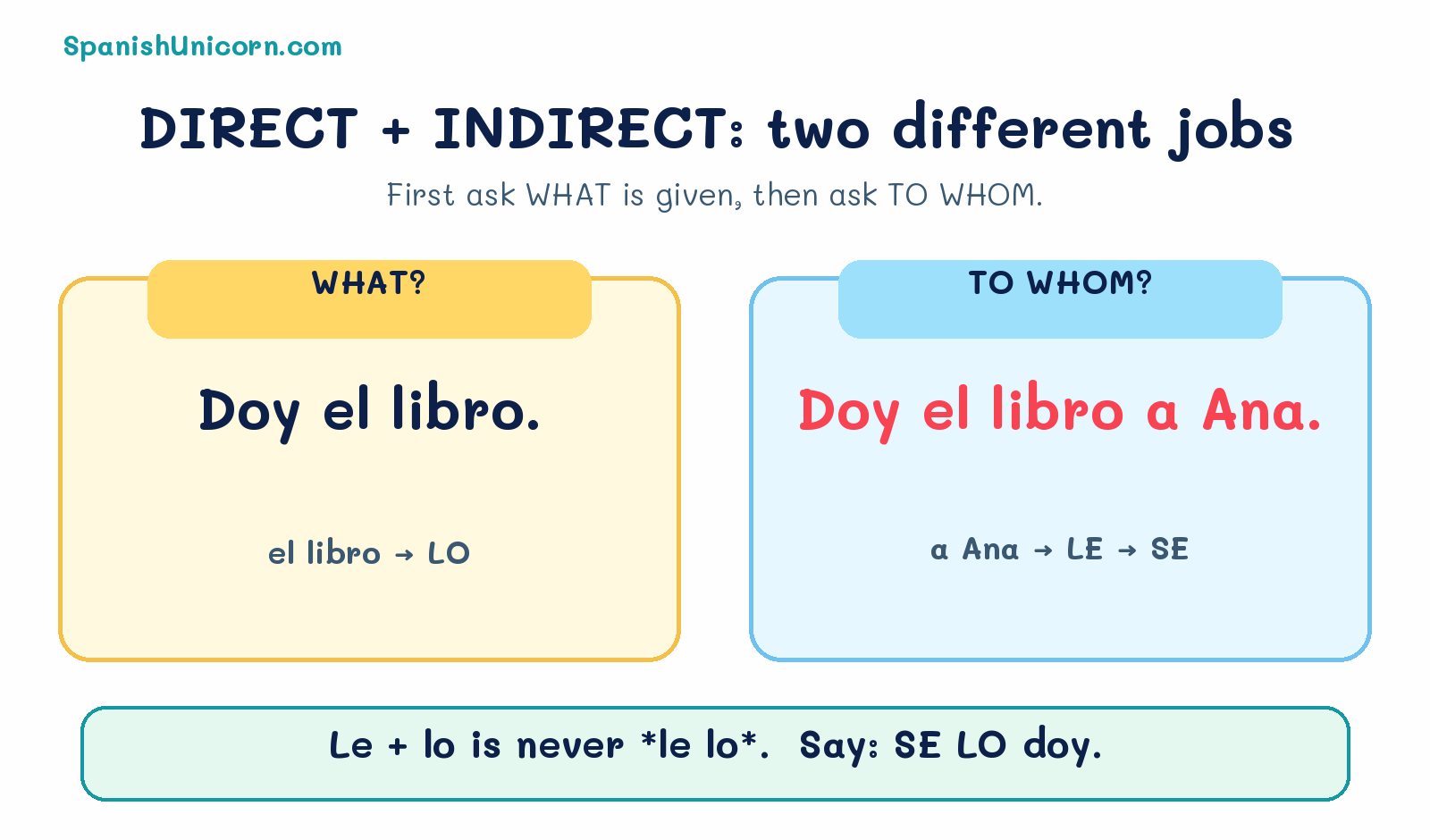
Ready for the sentence that looked impossible at the beginning? We start with Doy el libro a Marta. Replace el libro with lo. Replace a Marta with le. Spanish doesn’t put le lo together; it changes the indirect le to se. The result is Se lo doy.
Full sentence: Doy el libro a Marta.
Replace ‘the book’: Lo doy a Marta.
Replace ‘to Marta’ too: Se lo doy.
Indirect pronoun first → direct pronoun second.
This works with all four direct-object forms: se lo, se la, se los, se las. Try the same story with la carta: Entrego la carta a Ana → Se la entrego. With plural postcards: Mando las postales a mis padres → Se las mando.
Important: In this combination, se can stand for le or les. It doesn’t tell you whether there is one recipient or several. Context or an optional phrase can clarify: Se lo doy a ellos.
Not every se in Spanish comes from le. Compare Se lava (‘she washes herself’) with Se lo digo (‘I tell it to him/her/them’). Same spelling, different grammatical job. That’s why we look at the entire sentence.
Challenge 3 · Put the two pronouns together
Replace the direct and indirect object. Use se + lo/la/los/las where needed.
1. Doy el pan a Juan.
2. Entrego la carta a Ana.
3. Compré los billetes para Eva.
4. Explico las reglas a mis padres.
5. Mando las fotos a mi hermana.
6. Vendo el coche a José.
4. Where do the pronouns go? Four useful patterns
The meaning is clear; now place the pronouns correctly. In everyday Spanish, placement is often easier than learners expect because there are a few reliable patterns.
| Structure | Natural Spanish | What to notice |
|---|---|---|
| Conjugated verb | Lo compro. | Pronoun before the verb. |
| Infinitive after another verb | Lo quiero comprar / Quiero comprarlo. | Either before the conjugated verb or attached to infinitive. |
| Affirmative command | Dámelo. | Pronouns attach; accent can be needed. |
| Negative command | No me lo des. | Pronouns go before the negative command verb. |
Here’s a mini conversation: —¿Has comprado el regalo para Lucía? (‘Have you bought Lucía’s gift?’) —Sí, se lo he comprado. (‘Yes, I’ve bought it for her.’) The pronoun group goes before he because he comprado is a compound tense.
Don’t try to attach pronouns to a past participle in a normal perfect tense: lo he visto, not he vístolo. And don’t split the pair: se lo doy stays together in that order.
Write one sentence with an object you have and a person who might receive it. The pattern will become memorable because the people and objects are yours.
Challenge 4 · Put it in the right place
Write the missing form; include written accents when the command needs them.
1. No he visto. (the film, el filme)
2. ¿Quieres comprar el libro? Sí, quiero . (buy it)
3. , por favor. (Give it to me, tú; el libro)
4. No me lo . (Don't give it to me, tú)
5. A Elena explico la situación.
6. Voy a enviar la carta a Pablo. Voy a . (send it to him)
Your 10-second decision guide
1 · WHAT? Pick lo/la/los/las for the direct object. 2 · TO WHOM? Pick le/les for a third-person recipient. 3 · BOTH? Put the recipient first and change le/les to se: se lo doy.
If an infinitive or affirmative command follows, check whether the pronouns may or must attach. If there is a normal conjugated verb, put them in front.
Common mistakes worth fixing
- Assuming personal a means indirect object: Veo a Ana → La veo; Ana is the direct object.
- Using le lo: Standard Spanish changes le/les to se directly before lo/la/los/las.
- Swapping pronoun order: Se lo entrego, not lo se entrego.
- Attaching pronouns to a participle: Lo he visto, not he vístolo.
- Ignoring regional variation: Learn the widespread direct-object series first; later recognise accepted local leísmo rather than labelling every le veo wrong.
Frequently asked questions
What is the difference between lo and le?
As a beginner’s default, lo replaces a masculine singular direct object and le identifies a third-person indirect object. For example, Lo veo (I see him/it) versus Le doy un libro (I give him/her a book).
Why is it se lo and not le lo?
Spanish changes le and les to se when they come immediately before lo, la, los, las. This is a pronoun-combination rule, not a different verb tense.
Can se lo refer to more than one person?
Yes. Se in this sequence can replace either le or les. Add a él, a ella, a ellos or a name when you need to remove ambiguity.
Do I use la or le for a woman?
It depends on her grammatical role, not her gender alone. Veo a Elena → La veo (direct); Doy flores a Elena → Le doy flores (indirect).
Where do pronouns go with infinitives?
Both Lo quiero comprar and Quiero comprarlo are grammatical. With two pronouns, the group remains together: Se lo quiero dar / Quiero dárselo.
How do object pronouns work with commands?
Attach them to affirmative commands: Dámelo. Place them before negative commands: No me lo des. Some affirmative forms gain an accent when pronouns attach.
Keep learning with SpanishUnicorn
- Direct and indirect object exercises — practise deciding which role an object has
- Object pronouns with the present perfect — move the same pronouns into compound past tenses
- Pronouns in affirmative and negative commands — practise dímelo and no me lo digas
These lessons are in Spanish; use them for extra reading and interactive practice once you feel comfortable with the explanation above.
Grammar references and about us
For terminology, consult the verified RAE/ASALE entry for pronombre. Direct and indirect roles are illustrated above with complete sentences so the same surface form isn’t mistaken for the same grammatical function in every context. SpanishUnicorn is a Spanish-learning website with clear grammar explanations, free interactive exercises and printable practice materials. Start at SpanishUnicorn.com.
Found a mistake or have an idea?
Más de 6500 ejercicios, preguntas y retos
123 recursos A1–B2 y la guía «Empieza aquí».
Por separado: 991,36 €. Con el pack ahorras 792,36 €.
Ver los 123 recursos →Pago único · Sin suscripciónEntre los más elegidos
Una selección de nuestros materiales más vendidos en los últimos 90 días.
Los pasados en español · Pack esencial A2–B1 | 9 PDF + audios y aventura interactiva
Ver el material · 39,50 € →Presente de subjuntivo: conjugación | 20 actividades + 3 crucigramas | B1
Ver el material · 4,99 € →Pretérito indefinido – 40 ejercicios A2 + aventura interactiva
Ver el material · 9 € →Pack de subjuntivo | 10 cuadernos PDF · 200 actividades · B1-B2
Ver el material · 29,90 € →Más materiales de la tienda
CLASES LISTAS · PARA PROFES
Los pasados con historias · 3 clases listas para enseñar (A2–B1)
3 clases de 45 minutos · Guía docente, fichas y pantallas para proyectar.
Ver las 3 clases listas ↗