
Spanish Reflexive Verbs: Me, Te, Se + 24 Interactive Exercises
On 18/11/2026 by SpanishUnicornLast Updated on 18/11/2026 by SpanishUnicorn
Imagine you’re telling a friend about your morning. In English you say, ‘I get up, I shower, I get dressed.’ In Spanish, those three tiny actions often need one extra word: Me levanto, me ducho, me visto. That little me isn’t decoration. It’s the clue that the action belongs to the person doing it. Let’s make that clue feel natural, one useful routine at a time.
Quick answer: what are Spanish reflexive verbs?
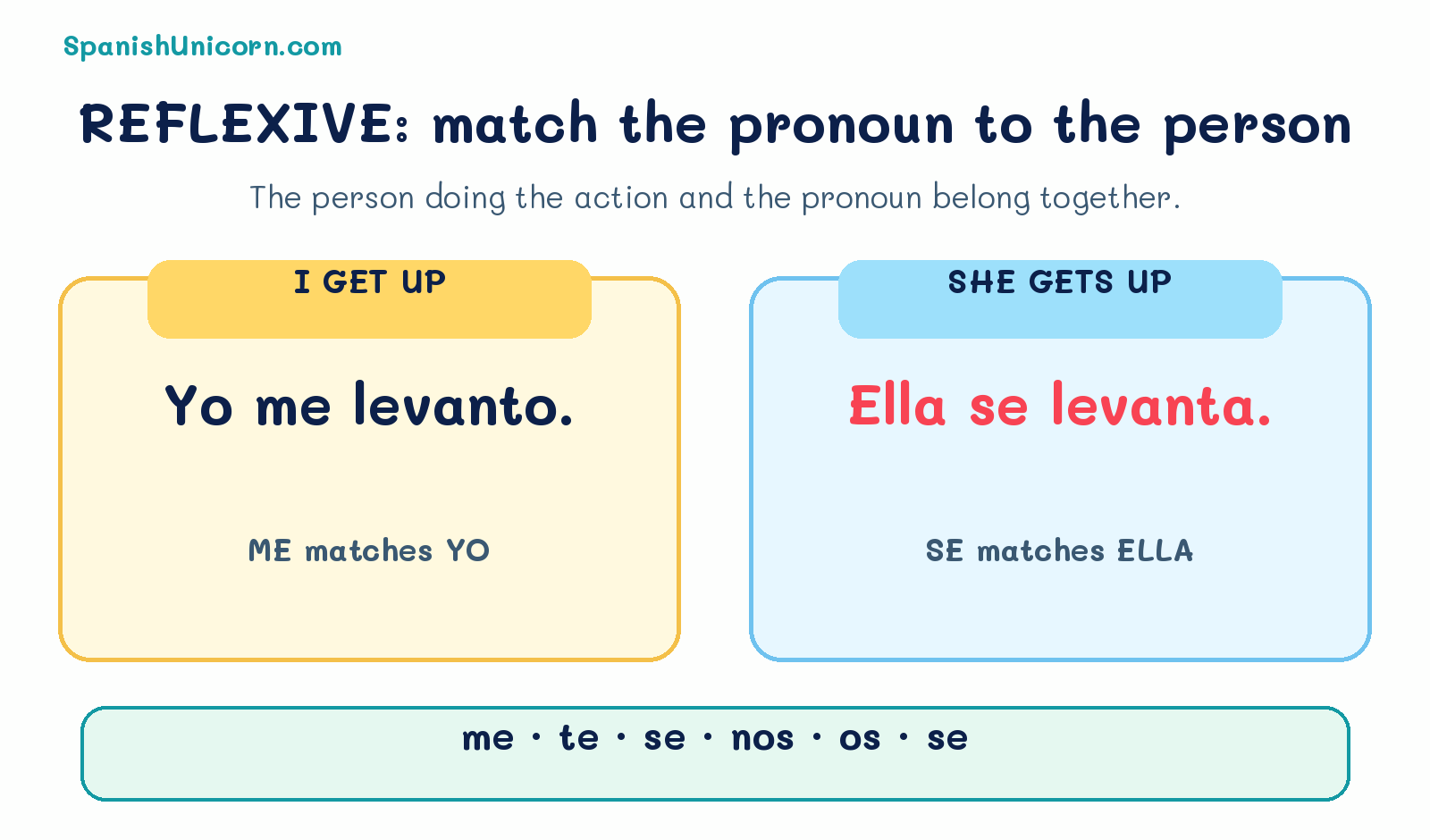
A reflexive construction uses a pronoun that refers back to the subject: me, te, se, nos, os, se. Say yo me lavo (I wash myself), tú te lavas (you wash yourself), ella se lava (she washes herself). Put the pronoun before a conjugated verb, or attach it to an infinitive: me voy a duchar / voy a ducharme. Not every verb ending in -se describes a literally reflexive action; some are simply pronominal verbs.
1. Meet the six little words: me, te, se, nos, os, se
When you look up a verb, you may see lavarse instead of lavar. That -se tells you the verb can be used with a pronoun. Before conjugating, remove the infinitive ending and choose the person: yo me lavo, not yo se lavo.
| Person | Reflexive pronoun | Lavarse |
|---|---|---|
| yo | me | me lavo |
| tú | te | te lavas |
| él / ella / usted | se | se lava |
| nosotros/as | nos | nos lavamos |
| vosotros/as | os | os laváis |
| ellos / ellas / ustedes | se | se lavan |
Spanish-speaking regions: In most of Latin America, ustedes se lavan is the normal plural ‘you’ form; Spain also uses vosotros os laváis among friends and family. You don’t need to use both varieties in the same conversation. Just recognise them when you hear them.
Useful contrast: Lavo el coche = I wash the car; Me lavo = I wash myself. The pronoun tells you who receives the action. With body parts, Spanish often prefers a definite article: Me lavo las manos, rather than translating English ‘my hands’ word for word.
Challenge 1 · Choose the matching pronoun
One subject, one reflexive pronoun. Choose the tiny word that belongs to the person.
1. Yo ___ levanto a las siete.
2. Tú ___ duchas después de correr.
3. Luisa ___ peina por la mañana.
4. Nosotros ___ acostamos temprano.
5. Vosotros ___ laváis las manos.
6. Mis hermanos ___ visten rápidamente.
2. Build a daily routine: stem changes and pronoun placement
Start with a few verbs you can actually use today: despertarse (wake up), levantarse (get up), ducharse (shower), vestirse (get dressed), cepillarse los dientes (brush your teeth) and acostarse (go to bed). The routine is easy to picture; the grammar gets easier when it has a story.
REGULAR
Me ducho.
I shower. Ducharse keeps the normal -ar endings.
STEM-CHANGING
Me despierto.
I wake up. Despertarse changes e → ie in most present-tense forms.
ANOTHER CHANGE
Me visto.
I get dressed. Vestirse changes e → i in the singular and third-person plural.
Here is a real rhythm: Me despierto a las siete, me levanto, me ducho y después me visto. (I wake up at seven, get up, shower and then get dressed.) You don’t need to repeat yo before every verb; the conjugated ending already tells the listener who is speaking.
With a single conjugated verb, the pronoun normally goes before it: me acuesto, not acuesto me. With common structures such as ir a, querer and tener que + infinitive, you have two good options: Me voy a acostar or Voy a acostarme. Both mean ‘I’m going to bed.’ Keep the pronoun matched to the person in either position.
Don’t forget the accent on forms such as tú te sientas versus vosotros os sentáis. The spelling isn’t optional; try to learn the sound together with the written form.
Challenge 2 · Conjugate a real routine
Write the missing present-tense verb form. The pronoun is already there.
1. Yo me a las siete. (despertarse)
2. Ella se muy rápido. (vestirse)
3. Nosotros nos después del café. (levantar)
4. Tú te tarde los sábados. (acostarse)
5. Yo me la chaqueta. (ponerse)
6. Vosotros os aquí. (sentarse)
3. Reflexive or not? The meaning can change
Not every -se verb is about looking in a mirror. Some are pronominal verbs: the pronoun is simply part of the usual construction. That’s why it’s worth learning verbs in short meaningful pairs rather than memorising a list of endings.
| Without a pronoun | With a pronoun |
|---|---|
| Lavo la taza. I wash the cup. |
Me lavo las manos. I wash my hands. |
| Pongo el libro en la mesa. I put the book on the table. |
Me pongo el abrigo. I put on my coat. |
| Voy al mercado. I’m going to the market. |
Me voy. I’m leaving. |
Ir and irse don’t differ only in who receives the action: irse often highlights departure. Likewise, acordarse de means ‘to remember’ and requires the pronoun in this expression: Me acuerdo de tu nombre. So use the label reflexive as a good first step, not as a promise that every -se has a literal English ‘myself’.
If you need an English shortcut, ask: ‘Is someone doing something to themselves?’ If yes, a reflexive construction may be likely. Then check whether Spanish actually uses that verb pronominally. Spanish and English don’t always divide actions in the same way.
For example, Me llamo Ana is how you introduce your name, but translating it mechanically as ‘I call myself Ana’ can make the everyday meaning feel stranger than it is. Learn whole mini-phrases: Me llamo… / Se llama….
Challenge 3 · Does the verb need -se?
Choose the sentence that expresses the English meaning without changing who receives the action.
1. I wash the car.
2. She puts on her coat.
3. We are leaving now.
4. I remember your name.
5. She washes her hands.
6. I am going to shower.
4. From grammar to a real morning conversation
Picture two friends talking over coffee before work. Read the short exchange aloud. The verbs carry useful real-life information: when someone starts the day, what they do and what they want to change.
Nora: ¿A qué hora te despiertas normalmente?
Leo: Me despierto a las siete, pero me levanto a las siete y media.
Nora: ¿Y después?
Leo: Me ducho, me visto y desayuno. ¿Y tú?
Nora: Me levanto más temprano. Por la noche intento acostarme antes de las once.
In English: Nora asks when Leo wakes up. He wakes at seven but gets out of bed at seven thirty, then showers, gets dressed and has breakfast. Nora gets up earlier and tries to go to bed before eleven.
Notice intento acostarme at the end. Because acostarse is an infinitive after intentar, the pronoun attaches to it. Nora could also have said Me intento acostar antes de las once. Both are grammatical.
Try your own two-sentence routine: Me levanto a las ___. Después, me ___. Say it aloud before checking the final practice. A grammar rule earns its place when it helps you say something true.
Challenge 4 · A day from start to finish
Complete the routine. Use the correctly conjugated verb, including accents.
1. Antes de salir, yo me el abrigo. (poner)
2. Después de cenar, Ana se los dientes. (cepillar)
3. Nosotros nos a las once. (acostar)
4. Por la mañana, tú te la cara. (lavar)
5. Mis amigas se temprano. (despertar)
6. Por la noche yo me a las diez. (acostar)
Your 10-second decision guide
Three quick questions: Who is the subject? What form does the main verb need? Does Spanish use this verb with a matching pronoun?
Yo → me; tú → te; ella → se; nosotros → nos. Place it before the conjugated form (me levanto) or attach it to an infinitive (quiero levantarme). Learn useful expressions like irse as phrases, too.
Common mistakes worth fixing
- Using se for everybody: yo me visto, not yo se visto.
- Dropping a required pronoun: For levantarse, learn me levanto as a unit. Despertar can also be used without se; this lesson practises despertarse. RAE: despertar.
- Forgetting stem changes: me despierto, me visto, me acuesto; but nos despertamos and nos acostamos.
- Translating possessives too literally: Prefer me lavo las manos for a normal routine.
- Moving the pronoun to the wrong place: Use voy a ducharme or me voy a duchar, not voy a me duchar.
Frequently asked questions
What does the -se mean in a Spanish infinitive?
It marks a pronominal use of the verb. For a genuinely reflexive action, the subject acts on themselves, as in lavarse. For other verbs, such as irse, the pronoun is part of an established construction.
Is me always reflexive?
No. Me can also be an object pronoun in other constructions. In me lavo, it refers back to the subject; in me gusta el café, it tells us who experiences the liking.
What is the difference between levantar and levantarse?
Levantar usually means to lift or raise something: levanto la caja. Levantarse commonly means to get up: me levanto a las siete.
Can a reflexive pronoun go after the verb?
Yes, when attached to an infinitive (ducharme), gerund (duchándome) or an affirmative command (dúchate). With an ordinary conjugated present-tense verb, it goes before: me ducho.
Why do Spanish speakers say me lavo las manos?
Spanish frequently uses the definite article with body parts when the pronoun already identifies whose body is involved. It is a natural Spanish pattern, not a word-for-word translation of English ‘my hands’.
Are reflexive verbs A1 or A2?
Basic daily-routine verbs such as levantarse and ducharse are commonly introduced at A1. Comparisons with non-pronominal verbs, placement and idiomatic changes in meaning can extend into A2 and beyond.
Keep learning with SpanishUnicorn
- Reflexive verbs: Spanish explanation and practice — get a Spanish-language overview with examples
- Reflexive verbs in the present — build fluency with daily-routine conjugations
- Conjugating 16 reflexive verbs — work verb by verb with the present tense
- Daily routine in Spanish — use the forms in a realistic routine
These lessons are in Spanish; use them for extra reading and interactive practice once you feel comfortable with the explanation above.
Grammar references and about us
For the definitions behind these constructions, see the verified RAE/ASALE entry for reflexivo and the RAE/ASALE entry for pronombre. SpanishUnicorn is a Spanish-learning website with clear grammar explanations, free interactive exercises and printable practice materials. Start at SpanishUnicorn.com.
Más ideas para tus clases.
123 recursos A1–B2 + tu guía «Empieza aquí». Menos tiempo preparando.
Ver All in One · 199 € →Pago único · Sin suscripciónEntre los más elegidos
Una selección de nuestros materiales más vendidos en los últimos 90 días.
Los pasados en español · Pack esencial A2–B1 | 9 PDF + audios y aventura interactiva
Ver el material · 39,50 € →Presente de subjuntivo: conjugación | 20 actividades + 3 crucigramas | B1
Ver el material · 4,99 € →Pretérito indefinido – 40 ejercicios A2 + aventura interactiva
Ver el material · 9 € →Pack de subjuntivo | 10 cuadernos PDF · 200 actividades · B1-B2
Ver el material · 29,90 € →Más materiales de la tienda
CLASES LISTAS · PARA PROFES
Los pasados con historias · 3 clases listas para enseñar (A2–B1)
3 clases de 45 minutos · Guía docente, fichas y pantallas para proyectar.
Ver las 3 clases listas ↗