• TIENDA
  • TIENDA
Spanish UnicornEjercicios de español
At the market
A1 . A1-A2 . Vocabulario

At the Market – Real Spanish for Real-Life Shopping #540

On 11/08/2025 by SpanishUnicorn

Last Updated on 22/09/2025 by SpanishUnicorn

If you’ve been following the last two posts – the one about going to the dentist and the one about shopping for vegetables – then this new lesson is for you. I’m sending it with lots of cariño (love!) to everyone who’s learning Spanish for real-life situations. Especially to my dentist-friend who’s already started learning words like zanahoria and muela – now it’s time to level up and go “At the Market”!

This post will teach you useful words, phrases, and grammar you need to buy food, ask prices, and understand Spanish-speaking vendors without panicking.

Tabla de Contenidos

Toggle
  • Vocabulary – Words & Phrases You’ll Actually Use
  • Grammar Focus (A1–A2)
    • 1. Querer + sustantivo
    • 2. Polite requests using usted form
    • 3. Tener + sustantivo
    • 4. Hay + sustantivo
    • 5. SingularSummary Table/plural and gender agreement
  • Summary Table
  • Ejercicios interactivos
      • 1. Vocabulario basico en el mercado
      • 2. Vocabulario basico en el mercado
      • 3. Un, una, unas, unos
      • 4. Choose the correct translation
      • 5. Put the dialogue in the correct order
  • Ejercicios relacionados
  • Soluciones – At the Market
  • 4.

Vocabulary – Words & Phrases You’ll Actually Use

SpanishEnglish
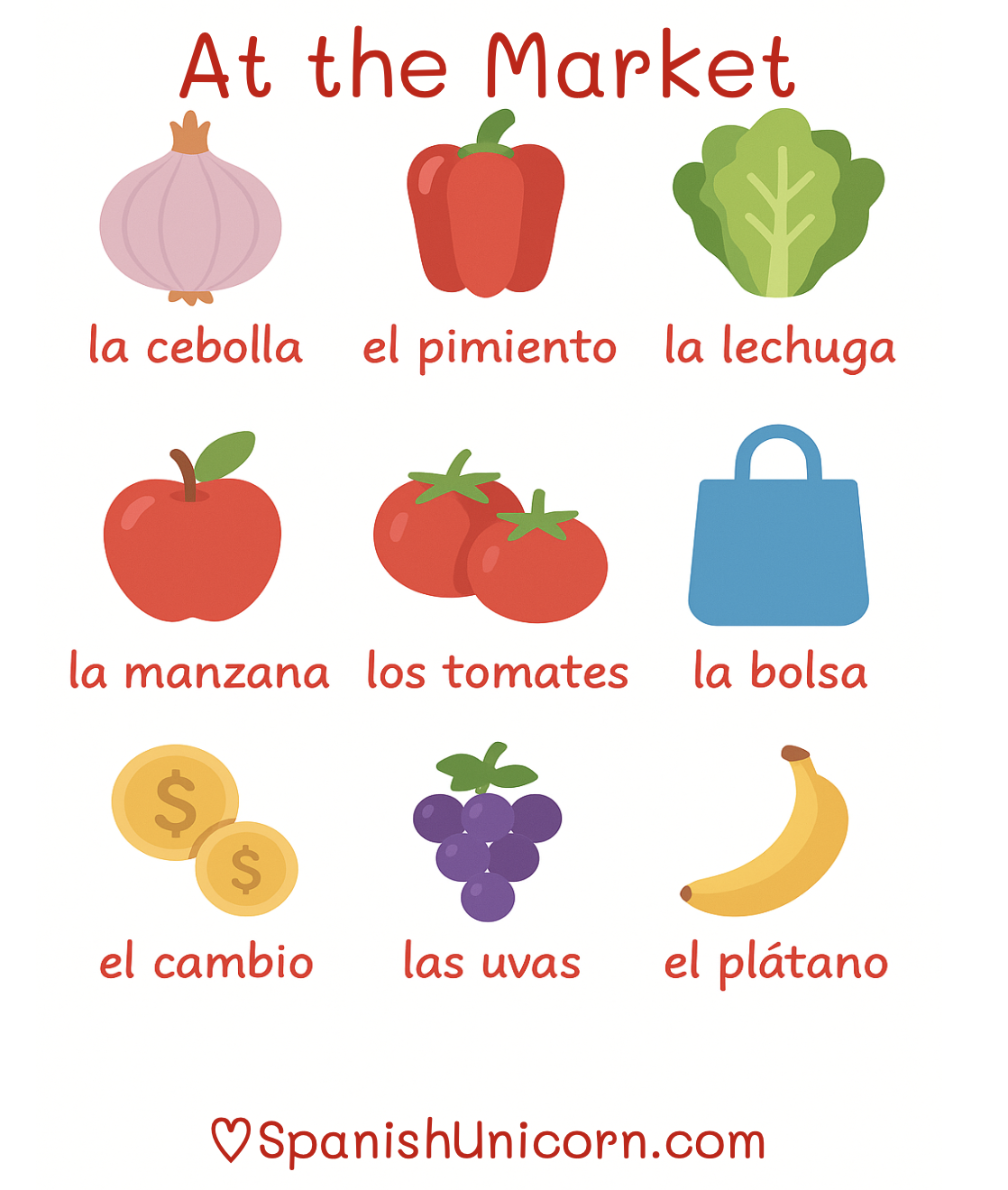
el mercadothe market
la frutafruit
la verduravegetable
la manzanaapple
la naranjaorange
el plátanobanana
la cebollaonion
el tomatetomato
la lechugalettuce
el pimientobell pepper
el kilokilo (kg)
¿Cuánto cuesta?How much is it?
¿Cuánto es?How much is it (total)?
Quiero…I want…
Me da…Can I have…
¿Tiene…?Do you have…?
Está maduro/aIt’s ripe
Está barato/caroIt’s cheap/expensive
Solo quiero mirarI’m just looking
Eso es todoThat’s all
Aquí tieneHere you go
Gracias / De nadaThank you / You’re welcome
el cambiochange (money)
At the Market

Grammar Focus (A1–A2)

1. Querer + sustantivo

To want + noun

We use querer to say what we want to buy.

Structure:
Querer + un / una / unos / unas + noun

Examples:

  • Quiero una manzana. → I want an apple.
    (una manzana = an apple)
  • Quiero un plátano. → I want a banana.
    (un plátano = a banana)
  • Quiero unas naranjas. → I want some oranges.
    (unas naranjas = some oranges)

2. Polite requests using usted form

Used with vendors to sound polite and respectful.
Structure:
Póngame + quantity + noun
Examples:
Póngame medio kilo de uvas, por favor. → I’d like half a kilo of grapes, please.
(uvas = grapes)
Póngame una bolsa de patatas. → I’d like a bag of potatoes.
(una bolsa de patatas = a bag of potatoes)2. Dar + objeto directo

To give + direct object

This structure is used to politely ask for something.
“Me da…” literally means “Can you give me…”

Examples:

  • Me da medio kilo de tomates, por favor. → Can I have half a kilo of tomatoes, please?
    (medio kilo de tomates = half a kilo of tomatoes)
  • ¿Me da una bolsa? → Can I have a bag?
    (una bolsa = a bag)

3. Tener + sustantivo

To have + noun

Used to ask if the seller has something.

Examples:

  • ¿Tiene plátanos maduros? → Do you have ripe bananas?
    (plátanos maduros = ripe bananas)
  • ¿Tiene cebollas? → Do you have onions?
    (cebollas = onions)

4. Hay + sustantivo

There is / there are + noun

Used to ask if something is available at the market.

Examples:

  • ¿Hay lechuga fresca hoy? → Is there fresh lettuce today?
    (lechuga fresca = fresh lettuce)
  • ¿Hay tomates? → Are there tomatoes?
    (tomates = tomatoes)

5. SingularSummary Table/plural and gender agreement

In Spanish, articles and adjectives must agree with the noun in gender (masculine/feminine) and number(singular/plural).

ArticleExample (Spanish)English translation
unun plátanoa banana
unauna manzanaan apple
unosunos tomatessome tomatoes
unasunas naranjassome oranges

Summary Table

StructureExample (Spanish)English meaning
Querer + nounQuiero una manzana.I want an apple.
Dar + direct objectMe da una bolsa, por favor.Can I have a bag, please?
Tener + noun¿Tiene cebollas?Do you have onions?
Hay + noun¿Hay tomates hoy?Are there tomatoes today?
Agreementunas naranjas / un plátanosome oranges / a banana
Usted commandPóngame medio kilo de uvas.I’d like half a kilo of grapes.
Aquí tieneAquí tiene su cambio.Here’s your change.

Ejercicios interactivos

1. Vocabulario basico en el mercado


2. Vocabulario basico en el mercado


3. Un, una, unas, unos


A1 A2 ejercicios de espanol
Buy this!

4. Choose the correct translation


5. Put the dialogue in the correct order


Ejercicios relacionados

  1. El plural
  2. Singular
  3. Pronombres indefinidos
  4. El plural de los sustantivos

Soluciones – At the Market

SpanishEnglish
¿Cuánto cuesta?How much does it cost?
¿Tiene plátanos maduros?Do you have ripe bananas?
¿Hay tomates hoy?Are there tomatoes today?
¿Tiene cebollas?Do you have onions?
¿Hay lechuga fresca?Is there fresh lettuce?
¿Tiene una bolsa?Do you have a bag?
¿Cuánto es?How much is it (total)?
¿Qué desea?What would you like?
¿Algo más?Anything else?
¿Dónde está el mercado?Where is the market?

Ejercicio 3.

  1. Quiero un plátano.
  2. ¿Tiene una cebolla.
  3. Dame un kilo de tomates.
  4. Compramos unas naranjas en el mercado.
  5. ¿Hay unos pimientos rojos?
  6. Quiero una manzana verde, por favor.
  7. Necesito una bolsa para las uvas.
  8. ¿Tienen unas uvas sin semillas?
  9. Llevo un tomate para la ensalada.
  10. Busco unas lechugas frescas.

4.

1. I want one banana.
2. How much is the apple? – ¿Cuánto cuesta la manzana?
3. Do you have ripe tomatoes? – ¿Tiene tomates maduros?
4. I’ll take a kilo of oranges. – Quiero un kilo de naranjas.
5. That’s all, thank you. – Eso es todo, gracias.
6. Do you have onions? – ¿Tiene cebollas?

5.

Vendedor: ¡Hola! ¿Qué desea?
Tú: Quiero un kilo de manzanas, por favor.
Vendedor: ¿Algo más?
Tú: No, eso es todo.
Vendedor: Aquí tiene. Son 3 euros.
Tú: Gracias.
Vendedor: ¡Que tenga buen día!
Tú: Igualmente, gracias.

At the Market Spanish
Tags: English, frutas y verduras, vocabulario
Sanish Coloring b
Ejercicios de subjuntivo
ejercicios para practicar los pasados - español
Ejercicios para practicar el pretérito perfecto de subjuntivo -21 ejercicios, pdf, A4
Pasados (Pretéritos) ejercicios de gramática espanola.
Indefinido o imperfecto ejercicios
Preterito indefinido ejercicios Spanish grammar exercises, past tense
Pretérito Pluscuamperfecto EJERCICIOS
indefinido o imperfecto ejercicios pdf
Pretérito perfecto ejercicios
futuro simple ejercicios pdf
Preposiciones ejercicios A1-A2, pdf
el o la, concordancia de género y número, ejercicios
Imperfecto ejercicios materiales para clases de espanol imprimir
conjugación presente ejercicios pdf
imperativo afirmativo ejercicios

Ejercicios de escucha* Vocabulario español * Ejercicios de gramática * Ejercicios de Pretérito Perfecto Ejercicios de Verbos Reflexivos Ejercicios de Verbos Irregulares en Presente * El Imperativo en Español * Ejercicios de Subjuntivo * Sobre nosotros* Contacto *Política de Cookies, Política de Privacidad

Copyright 2017- Spanishunicorn.com Contacto: [email protected]

Me encanta crear recursos para que aprendas español de forma divertida y efectiva. Si SpanishUnicorn te ha ayudado o te ha gustado el contenido, puedes invitarme un café virtual y ayudarme a seguir creando más materiales, ejercicios y juegos para ti. ¡Cada aporte hace la diferencia!
¡Gracias por tu apoyo!