
When to Use the Spanish Subjunctive: Clear Rules, Examples and Exercises
On 16/11/2026 by SpanishUnicornWhy do Spanish speakers say Creo que viene but No creo que venga? The person may be the same. The situation may be the same. Yet the final verb changes. That’s your first clue: the subjunctive is less about memorising a list of “trigger words” and more about how the speaker presents an idea. Let’s make that choice manageable.
Quick answer: when do you use the Spanish subjunctive?
Use the subjunctive in many clauses that express a wish, doubt, emotional reaction, evaluation or influence: Quiero que vengas; No creo que sea verdad; Me alegra que estés aquí. It also appears in certain future-oriented time clauses, such as Cuando llegues, llámame. The indicative usually presents information as a fact or belief: Creo que viene.
1. The subjunctive is not the “unreal tense”
First, it’s a mood, not one particular tense. Spanish has different subjunctive tenses. In this lesson we focus mainly on the present subjunctive, the forms you meet at B1 and use constantly at B2.
You’re often told that the subjunctive is for wishes or things that aren’t real. That can help with Quiero que vengas (I want you to come). But it fails with Me alegra que estés aquí (I’m glad you’re here). You are here — that’s real. The speaker is reacting emotionally to that fact, so the subordinate clause uses the subjunctive.
The useful question
Am I presenting information, or expressing a stance towards it — a wish, doubt, feeling or judgement?
2. Look at these two doors: indicative or subjunctive?
The difference becomes visible when you compare pairs. Don’t try to translate the English word that — it does not tell you which Spanish mood to use.
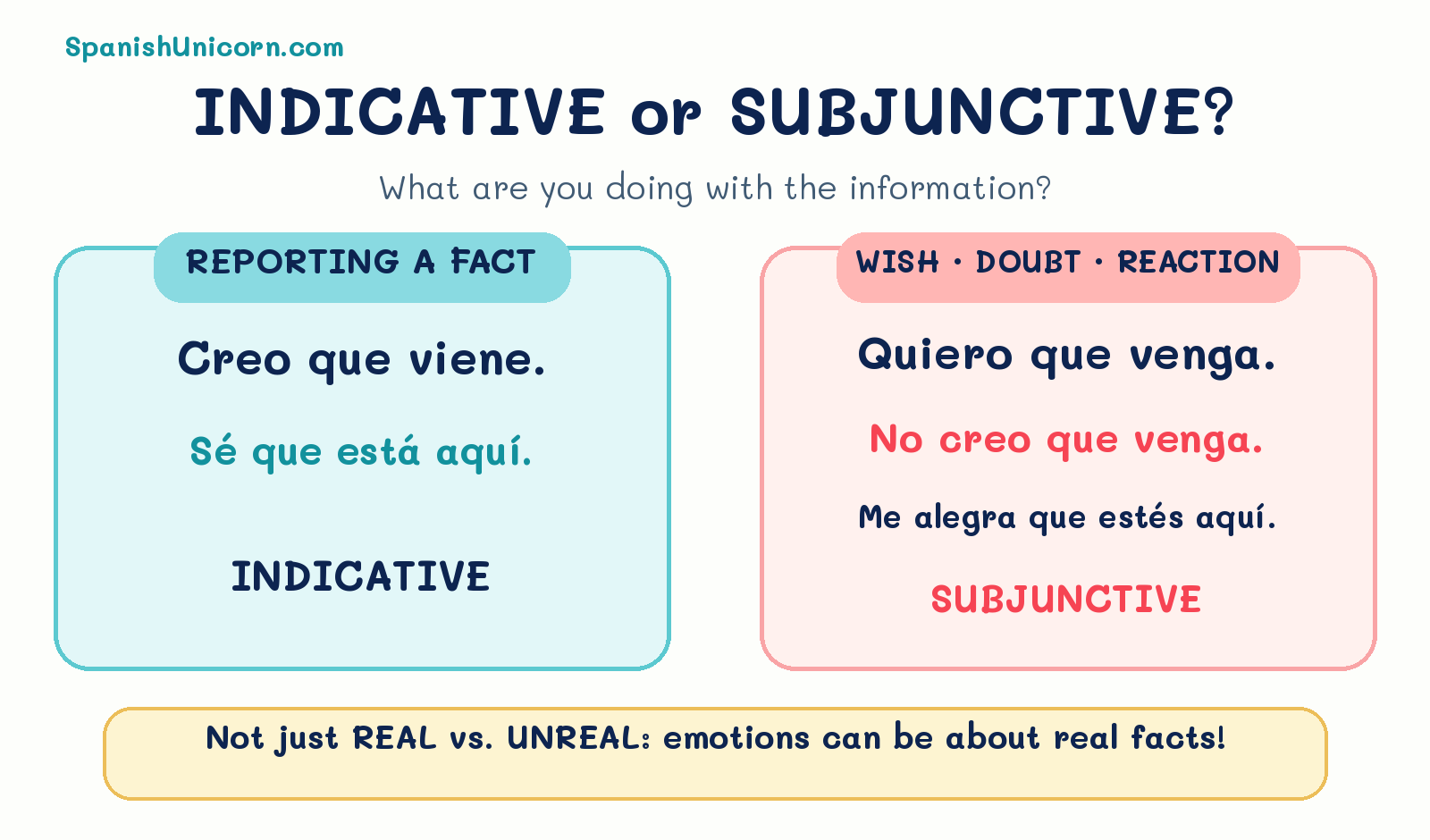
Notice something important in the first pair: the negative no creo que is a very common subjunctive context. But negation alone is not a universal switch. You still need to understand which idea is being denied and what type of clause follows.
Challenge 1 · Which mood?
Choose the form that matches how the speaker presents the idea.
1. Creo que Ana ___ en casa.
2. No creo que Ana ___ en casa.
3. Es cierto que Luis ___ razón.
4. Es posible que Luis ___ razón.
5. Me alegra que tú ___ aquí.
6. Sé que ellos ___ temprano.
3. Three everyday reasons to choose the subjunctive
WISH / INFLUENCE
Quiero que vengas.
I want you to come. Other patterns: Espero que… / Te recomiendo que…
REACTION
Me alegra que estés aquí.
I’m glad you’re here. Also: Me sorprende que… / Me molesta que…
EVALUATION
Es importante que estudies.
It’s important that you study. Also: Es mejor que… / Es necesario que…
There’s a very useful choice with the same person doing both actions. Compare Quiero viajar (I want to travel) with Quiero que tú viajes (I want you to travel). With one subject, the infinitive is usually natural. When you are influencing someone else’s action, que + subjunctive is common.
However, don’t turn that into a rule that every subjunctive sentence must have two named people. Ojalá llueva (I hope it rains) is perfectly normal without a que-clause. Es importante que duermas is a common impersonal evaluation.
How do you form the present subjunctive?
For many verbs, start from the present-tense yo form, remove -o and add the opposite set of endings: -ar verbs generally use -e/-es/-e/-emos/-en, while -er/-ir verbs use -a/-as/-a/-amos/-an. This is a starting framework, not a complete list of irregularities.
| Infinitive | Yo indicative | Tú subjunctive | Example |
|---|---|---|---|
| hablar | hablo | hables | Espero que hables. |
| comer | como | comas | Es bueno que comas. |
| vivir | vivo | vivas | Quiero que vivas aquí. |
Highly frequent irregular forms include sea (ser), esté (estar), vaya (ir), haya (haber), sepa (saber) and dé (dar). Do learn those as forms — the meanings of the constructions still tell you when to use them.
Challenge 2 · Make the form
Type the correct present subjunctive form from the verb in brackets.
1. Espero que tú (tener) tiempo mañana.
2. Es importante que ustedes (llegar) a tiempo.
3. Me alegra que nosotros (estar) aquí.
4. Ojalá (haber) plazas libres.
5. Quiero que Ana (venir) con nosotros.
6. Es mejor que tú no (hacer) eso.
4. When the future hasn’t happened yet
Some subordinate clauses refer to something that will happen later, so Spanish does not present it as a completed or habitual event. This is a common B1 step beyond wishes and doubts.
HABIT · indicative
Cuando llega, me llama.
Whenever she arrives, she calls me. A repeated habit.
FUTURE · subjunctive
Cuando llegue, te llamaré.
When she arrives, I’ll call you. The arrival is still ahead.
Other common patterns are en cuanto, hasta que and antes de que, depending on the sentence and meaning. For instance, Te avisaré en cuanto sepa algo (I’ll let you know as soon as I know something).
And what if the person or thing is not identified?
Compare Conozco un restaurante que tiene terraza (I know a restaurant that has a terrace) and Busco un restaurante que tenga terraza (I’m looking for a restaurant with a terrace — I haven’t identified one yet). The contrast is not a simple “real vs unreal” rule; it concerns whether the speaker presents an actual identified referent or a sought-after possibility.
The si trap: A real, open condition usually takes the indicative in the si-clause: Si llueve mañana, nos quedaremos en casa. Don’t write si llueva for that meaning. Hypothetical conditions such as Si tuviera tiempo, viajaría use the imperfect subjunctive — a different construction you will meet later.
Challenge 3 · Future or habit?
Decide by reading the whole sentence, not by looking only at the connector.
1. Cuando ___ tiempo mañana, te llamaré.
2. Cuando ___ tiempo, siempre te llamo.
3. Te lo explico para que lo ___.
4. Aún no conozco ninguno. Busco un piso que ___ terraza.
5. Tengo un piso que ___ terraza.
6. Si ___ mañana, nos quedaremos en casa.
5. A real-life story: planning a weekend away
Read the conversation for meaning first. Then look at how the speakers move from facts to plans, wishes and reactions.
Lucía: Sé que el hotel tiene habitaciones libres, pero no creo que esté cerca de la playa.
Diego: Busquemos otro que tenga terraza. Quiero que podamos desayunar fuera.
Lucía: Me alegra que quieras venir. Cuando lleguemos, podemos dar un paseo.
Diego: Espero que no llueva. Si hace buen tiempo, iremos al mar.
English reading: Lucía knows the hotel has rooms available but doubts it’s near the beach. Diego wants to find another one with a terrace so they can eat breakfast outside. Lucía is happy he wants to join. They plan a walk after arrival, and Diego hopes it won’t rain.
Notice five different jobs: tiene reports a fact; esté follows the doubted belief; tenga describes an as-yet-unidentified hotel; lleguemos looks to a future arrival; and hace stays indicative after a real si-condition.
Challenge 4 · Context decides
Mix facts, wishes, unknown things and conditions. Type the Spanish verb.
1. Sé que María (ser) muy organizada.
2. No creo que María (ser) egoísta.
3. Buscamos un hotel que (estar) cerca del mar; todavía no hemos encontrado uno.
4. En cuanto (terminar) la reunión de esta tarde, saldremos.
5. Es bueno que ustedes (practicar) cada día.
6. Si tú (poder) mañana, nos vemos.
6. Mistakes that make the subjunctive harder than it needs to be
- Thinking que always triggers the subjunctive. Creo que es fácil uses the indicative. The que just connects clauses; the construction and meaning select the mood.
- Using the subjunctive only for unreal events. Me alegra que estés bien can describe a fact you know is true.
- Confusing hope with knowledge. Compare Sé que viene and Espero que venga. The first reports knowledge; the second expresses hope.
- Using future tense after future cuando. Say Cuando llegues, salimos for a future plan, not cuando llegarás in that construction.
- Putting present subjunctive after every si. In a real condition: Si puedo, voy. Hypothetical si pudiera is a separate pattern.
- Forgetting the time relationship. When the main verb is in the past, you often need the imperfect subjunctive: Quería que vinieras. Don’t force today’s present forms into every past story.
7. Your one-minute decision map
1. Reporting?
A fact, knowledge or a positively stated belief? Start by checking whether the indicative fits: Sé que está.
2. Taking a stance?
Wish, influence, emotion, evaluation or doubt? Check for subjunctive: Espero que esté.
3. Still ahead?
Future time after cuando, an unknown referent after que, or a real si-condition? Let the whole construction decide.
Last check: It’s okay if more than one mood appears in the same story. People constantly switch between what they know, what they want and what they hope will happen. That’s what makes the subjunctive useful.
8. Frequently asked questions
Is the subjunctive a tense or a mood?
It’s a mood. Spanish has a present subjunctive, imperfect subjunctive and other subjunctive forms. This lesson focuses mainly on recognising and using the present subjunctive.
Does que always require the subjunctive?
No. Sé que tienes razón and Quiero que tengas razón both include que, but their meanings and grammar require different moods.
Do all negative statements take the subjunctive?
No. A common pair is Creo que viene versus No creo que venga. But negation doesn’t mechanically determine the mood in every construction. Listen to what the speaker is affirming or rejecting.
Can the subjunctive describe something real?
Yes. Me alegra que estés aquí can be said while you are standing right in front of the speaker. The subjunctive reflects the emotional reaction, not an assertion that you’re imaginary.
Do I use subjunctive after si?
For a real, open condition, normally use the indicative: Si llueve, nos quedamos en casa. For a hypothetical condition, the imperfect subjunctive appears: Si lloviera, nos quedaríamos en casa. Avoid si llueva for those meanings.
Can I use ojalá without que?
Yes. Ojalá tengas suerte is natural. You can also hear Ojalá que tengas suerte. Both express a wish and use the subjunctive.
Keep learning with SpanishUnicorn
- Usos del subjuntivo — the Spanish-language explanation of the key uses.
- Indicativo, subjuntivo or infinitivo? — decide what structure you need.
- Cuando + subjuntivo — routines versus future plans.
- Creer que / no creer que — practise opinions and doubt.
- 25 more subjunctive exercises — consolidate what you’ve learned.
These resources are in Spanish so that you move from an English explanation into authentic Spanish practice.
Official learning references
The Plan curricular del Instituto Cervantes is the official reference framework for Spanish proficiency levels, including B1–B2 grammar and communicative functions. SpanishUnicorn offers free online exercises and printable practice materials for learners and teachers.
Más ideas para tus clases.
123 recursos A1–B2 + tu guía «Empieza aquí». Menos tiempo preparando.
Ver All in One · 199 € →Pago único · Sin suscripciónEntre los más elegidos
Una selección de nuestros materiales más vendidos en los últimos 90 días.
Los pasados en español · Pack esencial A2–B1 | 9 PDF + audios y aventura interactiva
Ver el material · 39,50 € →Presente de subjuntivo: conjugación | 20 actividades + 3 crucigramas | B1
Ver el material · 4,99 € →Pretérito indefinido – 40 ejercicios A2 + aventura interactiva
Ver el material · 9 € →Pack de subjuntivo | 10 cuadernos PDF · 200 actividades · B1-B2
Ver el material · 29,90 € →Más materiales de la tienda
CLASES LISTAS · PARA PROFES
Los pasados con historias · 3 clases listas para enseñar (A2–B1)
3 clases de 45 minutos · Guía docente, fichas y pantallas para proyectar.
Ver las 3 clases listas ↗