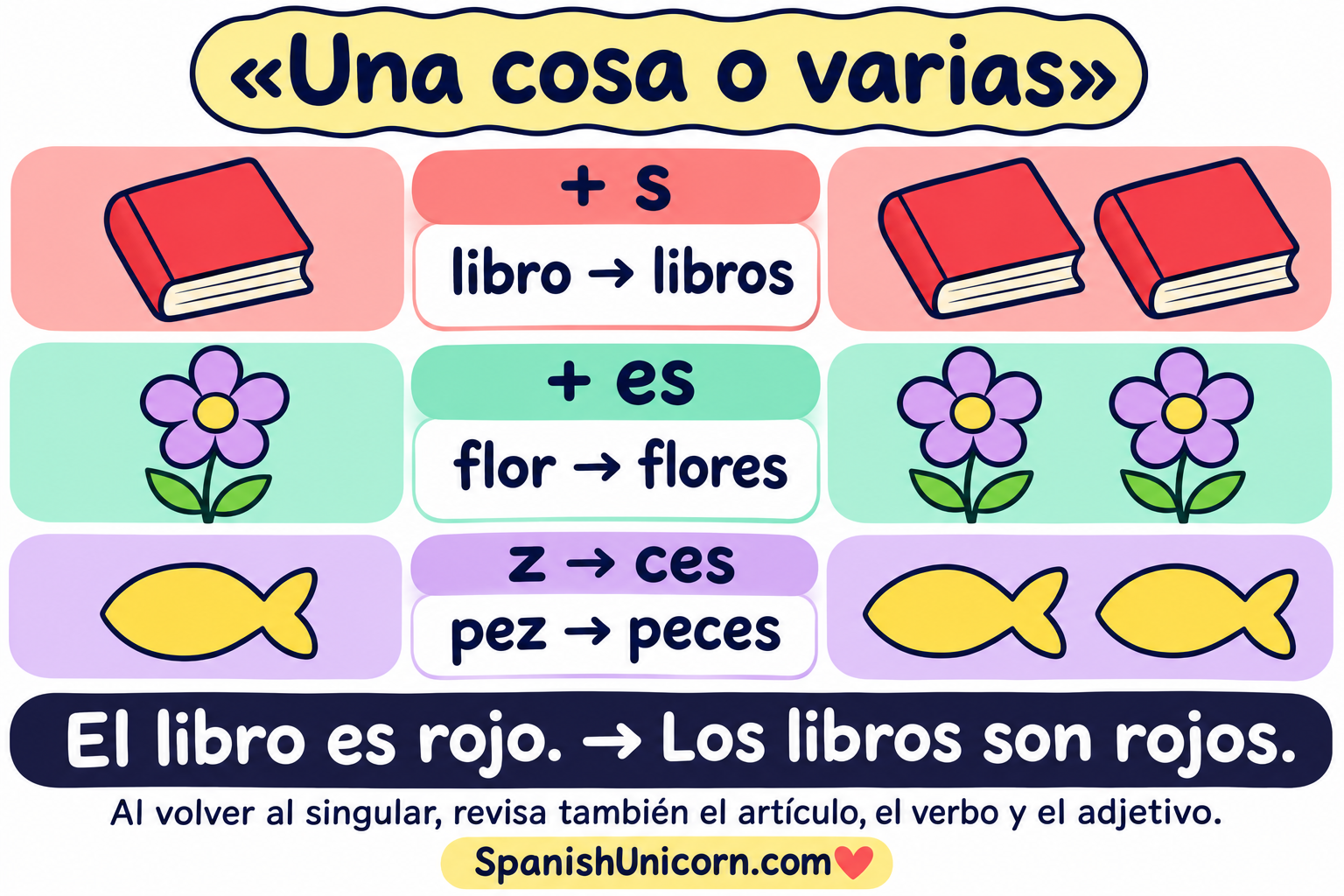
Cambia el artículo, el nombre y la palabra que describe al nombre.Change the article, the noun and the describing word. Start without a verb.
2. Es → son
Use these short “is / are” pairs.
Una cosa
El libro es rojo.
The book is red.
Más de una
Los libros son rojos.
The books are red.
Es cambia a son. Rojo cambia a rojos.Do not leave es unchanged when the subject becomes plural. The colour word changes too.
3. Está → están
A second “is / are” pattern: here / location.
Una cosa
La silla está aquí.
The chair is here.
Más de una
Las sillas están aquí.
The chairs are here.
Aquí significa “here”. No cambia. Está y están llevan tilde.Aquí stays the same. Keep the written accents in está and están. Here we practise number, not the full difference between ser and estar.
4. Palabras de ayuda
Use the same small set of familiar words.
negro = black · blanco = white · rojo = red · verde = green · azul = blue · grande = big · pequeño = small · nuevo = new · aquí = here
Azul → azules. Verde → verdes. Grande → grandes.Not every describing word takes just -s: azul becomes azules. The examples and answers show the full forms.
Trabaja en este orden: el gato negro → el gato es negro → el gato está aquí. Una pequeña frase cada vez.Follow the three blocks: a word group, a short description, then a short location sentence. If a block is difficult, repeat it before continuing.
Choose an answer. You do not need to type in these three blocks.
🦄SpanishUnicorn
A110 preguntasEjercicio interactivo
1. Grupos de palabras
Elige una opción en cada frase y comprueba tus respuestas al final.Choose one answer in each row. You can change your choices before checking.
0 / 1010 preguntas
1. el libro rojo (the red book) → plural:
El → los / la → las. También cambia el adjetivo. The describing word changes too.
2. la casa blanca (the white house) → plural:
El → los / la → las. También cambia el adjetivo. The describing word changes too.
3. el gato negro (the black cat) → plural:
El → los / la → las. También cambia el adjetivo. The describing word changes too.
4. la mesa pequeña (the small table) → plural:
El → los / la → las. También cambia el adjetivo. The describing word changes too.
5. el perro grande (the big dog) → plural:
El → los / la → las. También cambia el adjetivo. The describing word changes too.
6. la silla verde (the green chair) → plural:
El → los / la → las. También cambia el adjetivo. The describing word changes too.
7. el coche nuevo (the new car) → plural:
El → los / la → las. También cambia el adjetivo. The describing word changes too.
8. la ventana grande (the big window) → plural:
El → los / la → las. También cambia el adjetivo. The describing word changes too.
9. el bolso azul (the blue bag) → plural:
El → los / la → las. También cambia el adjetivo. The describing word changes too.
10. la puerta blanca (the white door) → plural:
El → los / la → las. También cambia el adjetivo. The describing word changes too.
0/10
0%
Soluciones / Answers · 1
los libros rojos — El → los / la → las. También cambia el adjetivo. The describing word changes too.
las casas blancas — El → los / la → las. También cambia el adjetivo. The describing word changes too.
los gatos negros — El → los / la → las. También cambia el adjetivo. The describing word changes too.
las mesas pequeñas — El → los / la → las. También cambia el adjetivo. The describing word changes too.
los perros grandes — El → los / la → las. También cambia el adjetivo. The describing word changes too.
las sillas verdes — El → los / la → las. También cambia el adjetivo. The describing word changes too.
los coches nuevos — El → los / la → las. También cambia el adjetivo. The describing word changes too.
las ventanas grandes — El → los / la → las. También cambia el adjetivo. The describing word changes too.
los bolsos azules — El → los / la → las. También cambia el adjetivo. The describing word changes too.
las puertas blancas — El → los / la → las. También cambia el adjetivo. The describing word changes too.
🦄SpanishUnicorn
A110 preguntasEjercicio interactivo
2. Es → son
Elige una opción en cada frase y comprueba tus respuestas al final.Choose one answer in each row. You can change your choices before checking.
0 / 1010 preguntas
1. El gato es negro. (The cat is black.) → plural:
El → los / la → las. Es → son. The verb changes too.
2. La casa es blanca. (The house is white.) → plural:
El → los / la → las. Es → son. The verb changes too.
3. El libro es rojo. (The book is red.) → plural:
El → los / la → las. Es → son. The verb changes too.
4. La mesa es pequeña. (The table is small.) → plural:
El → los / la → las. Es → son. The verb changes too.
5. El perro es grande. (The dog is big.) → plural:
El → los / la → las. Es → son. The verb changes too.
6. La silla es verde. (The chair is green.) → plural:
El → los / la → las. Es → son. The verb changes too.
7. El coche es nuevo. (The car is new.) → plural:
El → los / la → las. Es → son. The verb changes too.
8. La ventana es grande. (The window is big.) → plural:
El → los / la → las. Es → son. The verb changes too.
9. El bolso es azul. (The bag is blue.) → plural:
El → los / la → las. Es → son. The verb changes too.
10. La puerta es blanca. (The door is white.) → plural:
El → los / la → las. Es → son. The verb changes too.
0/10
0%
Soluciones / Answers · 2
Los gatos son negros. — El → los / la → las. Es → son. The verb changes too.
Las casas son blancas. — El → los / la → las. Es → son. The verb changes too.
Los libros son rojos. — El → los / la → las. Es → son. The verb changes too.
Las mesas son pequeñas. — El → los / la → las. Es → son. The verb changes too.
Los perros son grandes. — El → los / la → las. Es → son. The verb changes too.
Las sillas son verdes. — El → los / la → las. Es → son. The verb changes too.
Los coches son nuevos. — El → los / la → las. Es → son. The verb changes too.
Las ventanas son grandes. — El → los / la → las. Es → son. The verb changes too.
Los bolsos son azules. — El → los / la → las. Es → son. The verb changes too.
Las puertas son blancas. — El → los / la → las. Es → son. The verb changes too.
🦄SpanishUnicorn
A110 preguntasEjercicio interactivo
3. Está → están
Elige una opción en cada frase y comprueba tus respuestas al final.Choose one answer in each row. You can change your choices before checking.
0 / 1010 preguntas
1. El gato está aquí. (The cat is here.) → plural:
El → los / la → las. Está → están. Aquí = here; it does not change.
2. La silla está aquí. (The chair is here.) → plural:
El → los / la → las. Está → están. Aquí = here; it does not change.
3. El libro está aquí. (The book is here.) → plural:
El → los / la → las. Está → están. Aquí = here; it does not change.
4. La mesa está aquí. (The table is here.) → plural:
El → los / la → las. Está → están. Aquí = here; it does not change.
5. El perro está aquí. (The dog is here.) → plural:
El → los / la → las. Está → están. Aquí = here; it does not change.
6. La casa está aquí. (The house is here.) → plural:
El → los / la → las. Está → están. Aquí = here; it does not change.
7. El coche está aquí. (The car is here.) → plural:
El → los / la → las. Está → están. Aquí = here; it does not change.
8. La ventana está aquí. (The window is here.) → plural:
El → los / la → las. Está → están. Aquí = here; it does not change.
9. El bolso está aquí. (The bag is here.) → plural:
El → los / la → las. Está → están. Aquí = here; it does not change.
10. La puerta está aquí. (The door is here.) → plural:
El → los / la → las. Está → están. Aquí = here; it does not change.
0/10
0%
Soluciones / Answers · 3
Los gatos están aquí. — El → los / la → las. Está → están. Aquí = here; it does not change.
Las sillas están aquí. — El → los / la → las. Está → están. Aquí = here; it does not change.
Los libros están aquí. — El → los / la → las. Está → están. Aquí = here; it does not change.
Las mesas están aquí. — El → los / la → las. Está → están. Aquí = here; it does not change.
Los perros están aquí. — El → los / la → las. Está → están. Aquí = here; it does not change.
Las casas están aquí. — El → los / la → las. Está → están. Aquí = here; it does not change.
Los coches están aquí. — El → los / la → las. Está → están. Aquí = here; it does not change.
Las ventanas están aquí. — El → los / la → las. Está → están. Aquí = here; it does not change.
Los bolsos están aquí. — El → los / la → las. Está → están. Aquí = here; it does not change.
Las puertas están aquí. — El → los / la → las. Está → están. Aquí = here; it does not change.
Una práctica de un minuto
One minute without answer buttons.
Di: el libro es rojo. Ahora habla de dos libros. Después: la silla está aquí. Habla de dos sillas.Make two short sentences plural. Check the article, noun, verb and describing word.
Dudas / Quick help
¿Los gatos es negros?
No: los gatos son negros. Es becomes son.
¿Aquí cambia?
No. Aquí means here and stays unchanged.
Material anterior / Older material
Estos recursos son de la versión anterior. Pueden tener más dificultad.These archive resources may contain harder vocabulary or longer sentences. They are optional, not the beginner route.
Me encanta crear recursos para que aprendas español de forma divertida y efectiva. Si SpanishUnicorn te ha ayudado o te ha gustado el contenido, puedes invitarme un café virtual y ayudarme a seguir creando más materiales, ejercicios y juegos para ti. ¡Cada aporte hace la diferencia! ¡Gracias por tu apoyo!
SpanishUnicorn en las aulas de todo el mundo
Nuestros materiales llegan a docentes y estudiantes de centros educativos de todo el mundo.
Recursos para aprender y enseñar español como lengua extranjera.
Utilizamos cookies necesarias para el funcionamiento de SpanishUnicorn. Medimos las visitas con Independent Analytics, sin cookies analíticas. Algunos contenidos y servicios externos pueden utilizar tecnologías opcionales: puedes aceptarlas o rechazarlas y cambiar tu elección cuando quieras.
Puedes cambiar tu consentimiento en cualquier momento.